Brand: SPL

  • SPL MADISON – 16+16 Channel AD/DA Converter and MADI Interface

    SPL MADISON – 16+16 Channel AD/DA Converter and MADI Interface

    Madison

    16+16 Channel MADI Interface

    The SPL Madison offers the pure SPL analog sound for every MADI equipped digital console, audio router and PC MADI card.

    With 16 input and 16 output channels in a single rack space, the Madison combines state of the art signal conversion with highly reliable clock and MADI processing. And as a true SPL unit it is simple to operate, easy to expand and, of course, an awesome sounding conversion system.


    • 16 AD and 16 DA converters in 1U
    • Superb sounding converters with a sophisticated analog section on 36V audio rails
    • +24dBu professional output level
    • Best price/performance value
    • Up to 64 I/Os on 1 MADI port (4 units)
    • Latency-neutral MADI chaining
    • 44.1 to 192kHz, ±10% vari-speed
    • SPL clock-shop for jitter-free operation
    • Ultra-compatible, always operational MADI IO with ultra low conversion latencies
    • Four directly selectable reference levels: 15/18/22/24
    • Simple operation and setup right from the front panel controls
    • Ergonomic, distance-readable meters for clear level status indication of any I/O channel
    • Fanless, absolutely silent low-power design (max. 30W)
    • Redundant power supply optionally
    • Four analog, 8-channel multicore DB25 sockets (TASCAM industry standard)
    • Made in Germany

    Why MADI?

    Broadcast and live professionals rely on the still-unsurpassed MADI since about 20 years now – with jitter-free, rock-solid transmission of many audio channels per single wire and low-cost cabling with lengths far above one mile, MADI simply offers unique advantages.


    Why Madison?

    As a company with a rich heritage in analog audio engineering, it has always been our idea to put all our knowledge into the analog sections of a converter. Excellent converter technology requires an appropriate analog environment, and that is where a true difference can be made – a difference against existing solutions, and a difference in sound of course.

    We have designed an analog audio section on 36V audio rails, reaching output levels of 24dBu. The result is simply amazing. With its straight-forward operation, flexible expansion, and pristine sound, the price per channel ratio of the Madison may set a new benchmark.

    And for the first time, SPL’s analog sound is coming to digital environments.


    A good fit everywhere

    Thanks to its rich I/O equipment, the Madison makes it a breeze to integrate professional analog gear into larger multichannel infrastructures. With four popular reference levels, operational sample rates between 44.1 and 192kHz, multicore analog I/O, fibre MADI I/O and word clock I/O, the Madison simply fits everywhere.

    Up to four units can be connected to a single MADI port on a digital console, a MADI PC card, or any professional audio routing infrastructure. The MADI port offers excellent and near-zero-latency digital transmission of up to 64 I/Os with galvanic insulation. And since MADI is the emerging new studio I/O standard, the Madison is the perfect interface for home and project studios, commercial recording studios and scoring stages.

    So whereever you may have a need for reliable and pure conversion of multiple analog audio channels, the Madison meets your demand brilliantly.


    Converter and Connections

    Resolution: 24 Bit
    Sample Rates: 44.1, 48, 88.2, 96, 176.4, 192 kHz
    Varispeed: ±12.5% in 56 CH mode, -12,5% in 64 CH mode
    Reference Levels/Inputs: 24dBu max, selectable 22dBu, 18dBu, 15dBu
    Reference Levels/Outputs: 24dBu max, selectable 22dBu, 18dBu, 15dBu
    Clock: Internal clock circuitry from SPL, Wordclock or MADI
    Expandability: 4 units via MADI chain for 64 channels
    Wordclock: Input 75 ohms, terminated impedance
    Wordclock Level: Input TTL/CMOS5/CMOS3; Output 3.3Vtt
    MADI channels@44,1 & 48kHz: 56/64ch
    MADI channels@2x 44,1 & 48K: 28/32ch
    MADI channels@4x 44,1 & 48K: 14/16ch
    MADI formats@2x 44,1 & 48K, 4x 44,1 & 48kHz: SMUX/HighSpeed
    Audio Inputs   
    16 analog, balanced inputs, DB25/Tascam
    MADI optical digital input (up to 64 channels)
    Audio Outputs   
    16 analog, balanced outputs, DB25/Tascam
    MADI optical digital output (up to 64 channels)

     
    Analog Inputs/Measurements

    S/N: 115dB (A-weighted, 48kHz)
    Dynamic Range: 115dB (-60dBfs, A-weighted, 48kHz)
    S/(N+D): 102dB ( -1dBfs, 48kHz)
    Interchannel Isolation: 110dB (48kHz)
    Passband Response: 22kHz (-0.02dB, 48kHz)
    Passband Ripple: +/- 0.005dB (Decimation-LPF, 48kHz)
    Stopband Attenuation: 100dB (Decimation-LPF, 48kHz)

     
    Analog Outputs/Measurements

    S/N: 115dB (A-weighted, 48kHz)
    Dynamic Range: 115dB (-60dBfs, A-weighted, 48kHz)
    S/(N+D): 100dB (-1dBfs, 48kHz)
    Interchannel Isolation: 110dB (48kHz)
    Passband Response: 21.8kHz (-0.04dB, 48kHz)
    Passband Ripple: +/- 0.06dB (Digital Filter, 48kHz)
    Stopband Attenuation: 70dB (Digital Filter, 48kHz)

     
    Rear Connections

    1 IEC power connector
    USB Type A socket (no audio, firmware updates only)
    Wordclock input via BNC socket with Termination switch
    Wordclock output via BNC socket with Termination switch
    MADI optical input, Type SC
    MADI optical output, Type SC
    2 x DB25 8-channel analog inputs (Tascam)
    2 x DB25 8-channel analog outputs (Tascam)

     
    Power Supply, BTU, Dimensions & Weight

    Power Supply: Switchmode, 90-264 V AC, 50/60 Hz, 35W max.
    Thermal Units: 65 BTU/h typ., 110 BTU/h max.
    Dimensions (HxWxD, mm): 44 x 482 x 260 (without sockets D=240)
    Dimensions (HxWxD, inch): 1,7 x 19 x 10,2 (without sockets D=9,4)
    Weight kg: 3,05 (3,17 with 2nd Power Supply)
    Weight lbs: 6,72 (6,99 with 2nd Power Supply)

  • SPL MC16 16 Channel Mastering Monitor Controller- BLACK

    SPL MC16 16 Channel Mastering Monitor Controller- BLACK

    MC16
    16 Channel Mastering Monitor Controller
    Today’s mastering studio must be prepared for Dolby Atmos® and Auro 3D® projects. Monitoring up to 16 channels in a quality that is on par with state-of-the-art stereo was hard to achieve – until now.
    The new MC16 sports the world’s first 16-gang precision potentiometer which was specially designed for SPL.

    To seamlessly integrate multi-channel monitoring into a stereo mastering environment we developed a way of pairing the MC16 with our new DMC stereo mastering console. The combination of DMC and MC16 allows mastering studios to work in all current audio playback formats at the same quality level, all without reconnecting any speakers.

  • SPL MC16 16 Channel Mastering Monitor Controller- RED

    SPL MC16 16 Channel Mastering Monitor Controller- RED

    MC16
    16 Channel Mastering Monitor Controller
    Today’s mastering studio must be prepared for Dolby Atmos® and Auro 3D® projects. Monitoring up to 16 channels in a quality that is on par with state-of-the-art stereo was hard to achieve – until now.
    The new MC16 sports the world’s first 16-gang precision potentiometer which was specially designed for SPL.

    To seamlessly integrate multi-channel monitoring into a stereo mastering environment we developed a way of pairing the MC16 with our new DMC stereo mastering console. The combination of DMC and MC16 allows mastering studios to work in all current audio playback formats at the same quality level, all without reconnecting any speakers.

  • SPL MIC IN LUNDHAL TRANSFORMER KIT LL1538 – 2161

    SPL MIC IN LUNDHAL TRANSFORMER KIT LL1538 – 2161

    Lundahl I/O Transformers
    Line In 2051, Line Out 2052, Mic In 2161
    Units with transformer options
    Units with transformer option are built to order. Please ask your dealer for a BTO unit according to your desired configuration, even if transformer-equipped units are not offered (e. g. in a web shop system). Forward contact details to us if order details need to be clarified.

    Frontliner: Input and output (Models 2161 and 2052)
    Channel One: Input and output (Models 2161 and 2052)
    Track One: Input transformer only (Model 2161)
    GainStation 1: Input transformer only (Model 2161)
    GainStation 8 Mk2: Input transformer only (Model 2161)
    GoldMike Mk2: Inputs and outputs (Models 2161 and 2052)
    Qure: Inputs and outputs (Models 2051 and 2052)
    Kultube: Inputs and outputs (Models 2051 and 2052)
    Units with transformers
    MixDream: Built-in output transformers (switchable, no further options)
    Sound
    We think a good part of the “warmth” that is commonly associated with vintage gear comes from transformers. With transformers the low end and lower mids sound rounder, full-bodied with more punch. The top end gets a silky touch and benefits from improved presence without sounding boosted. Reasons are reduced odd harmonics (which produce harsh top end impressions) and a slower characteristic compared to electronic stages which causes a more voluminous sound.
    We recommend transformers especially for vocals while electronic stages can be better for highest precision in signal transmission (transients), but in the end it’s a question of personal taste, applications or for example which mics are in use.

    Transformers in preamps
    Used in SPL preamps or channel strips, the input transformers add ca. 14dB gain (depending on the microphone). This must be added to the scaled values. The additional passive gain relieves the complete unit permanently at any gain level. That’s why the input transformer is more important in preamps, but to benefit from all possible sonic effects and full operational safety, both input and output should be equipped with transformers. If SPL preamps only offer an input transformer option, the simple reason is not enough space.

    Operational safety
    Transformers transmit the signal by induction. This means there is no static connection (like a wire) to transmit the signal. This protects the unit from damage caused by power failures in the input/output connections. In addition, hum problems are effectively avoided if balanced connections are used throughout. That’s why transformers can be very interesting for live units or in units used in facilities that need highest operational safety (broadcast, sound reinforcement). Another notable advantage for many live and recording applications is that much longer cable lengths are possible with no loss in signal quality.

    Prices, mounting
    Units with transformer option can be built to order. Please ask your dealer for a BTO unit even if transformer-equipped units are not offered (e. g. in a web shop system).

    Since Lundahl transformers are precious hand made components and their use depends on individual taste, conditions or environments, we offer them as an option to let each user decide on this investment. Transformers can be equipped also after purchase by qualified technicians. Please contact your local distributor for details on pricing and mounting.

  • SPL MIXDREAM – 2384 16 x 2 Analog Summing Mixer

    SPL MIXDREAM – 2384 16 x 2 Analog Summing Mixer

    MixDream

    Analog Summing Unit with 16 Inserts

    The MixDream is a cascadable, 16-in-2 analog summing device. Any DAW or digital console can be expanded with active analog summing, channel and main bus and inserts and processing.

    The MixDream discrete class A technology is based on a 60-volt rail (+/- 30V). This ensures extremely high slew rates, low noise level of -97dBu (A-weighted, all channels active) and a dynamic range of over 125dB. Thus the MixDream outperforms the technical level of the best analog consoles.

    “So far, I’ve used three different summing systems with DAWs and I’ve noticed the biggest sonic improvement yet while using the MixDream.” Mix Magazine (US).

    The MixDream is a cascadable, 16-in-2 analog outboard mixer in a 19“/2U format. Any DAW or digital console can be expanded with active analog stereo summing and insert functionality.

    MixDream advantages

    • High-grade analog summing on just 2U rack space
    • Sophisticated, active Class A/60V stages for analog summing in the quality of the best consoles
    • 16 balanced inserts allow for integrated analog effects with individual and overall hard bypass relays
    • Reduction of A/D conversions (14 A/D conversions can be spared with all inserts connected). All analog tracks can be summed before A/D conversion.
    • Channel adjustments and automation (level, panorama etc.) remain controlled from the DAW so the user loses no digital efficiency
    • Lower DAW processor utilization rates
    • The most efficient possible re-sampling of individual tracks with latency free monitoring
    • Surround capable (from up to 3 MixDream units)
    • Channel capacity expandable through linked units
    • Sensitive and transparent stereo expansion control
    • Analog peak limiter for impressive loudness
    • Master inserts and switchable output transformers from Lundahl
    • Optimized signal pathes, all switching functions via relays
    • Proprietary differential amplifiers for each input
    • Discrete, exceptionally low-noise power supply
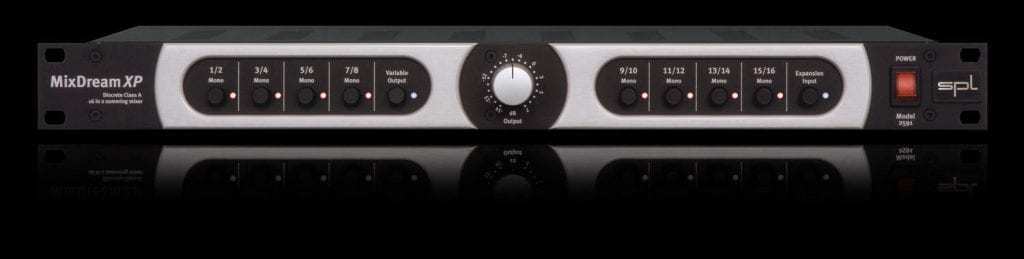
  • SPL MIXDREAM XP – 2591 16×2 Analog Summing Mixer

    SPL MIXDREAM XP – 2591 16×2 Analog Summing Mixer

    MixDream XP

    16+2 Channel Class-A Summing Unit

    The MixDream is a cascadable, 16-in-2 analog summing device that expands any DAW with high-grade analog stereo summing functionality.

    One MixDreamXP can sum up to 16 audio tracks to a stereo signal, and should the need arise for more than 16 tracks, several MixDreamXP may be linked together. Owners of a MixDream can expand this unit with the cost effective MixDreamXP at an identical quality level and by the way, that‘s where the suffix „XP“ comes from (=Expansion).

    The MixDreamXP discrete class A technology is based on the same 60-volt rails (+/- 30V) used in the fully featured MixDream.

    So far, I’ve used three different summing systems with DAWs and I’ve noticed the biggest sonic improvement yet while using the MixDream.” Mix Magazine (US).

    The MixDream is a cascadable, 16-in-2 analog outboard mixer in a 19“/2U format. Any DAW or digital console can be expanded with active analog stereo summing and insert functionality.

    MixDream advantages

    • High-grade analog summing on just 2U rack space
    • Sophisticated, active Class A/60V stages for analog summing in the quality of the best consoles
    • 16 balanced inserts allow for integrated analog effects with individual and overall hard bypass relays
    • Reduction of A/D conversions (14 A/D conversions can be spared with all inserts connected). All analog tracks can be summed before A/D conversion.
    • Channel adjustments and automation (level, panorama etc.) remain controlled from the DAW so the user loses no digital efficiency
    • Lower DAW processor utilization rates
    • The most efficient possible re-sampling of individual tracks with latency free monitoring
    • Surround capable (from up to 3 MixDream units)
    • Channel capacity expandable through linked units
    • Sensitive and transparent stereo expansion control
    • Analog peak limiter for impressive loudness
    • Master inserts and switchable output transformers from Lundahl
    • Optimized signal pathes, all switching functions via relays
    • Proprietary differential amplifiers for each input
    • Discrete, exceptionally low-noise power supply
  • SPL MTC – Stereo Monitor & Talkback Controller

    SPL MTC – Stereo Monitor & Talkback Controller

    SPL MTC Stereo Monitor & Talkback Controller with talkback & cue mixing function

    MTC

    Stereo MonitoråÊ& Talkback Controller

    The MTC combines volume level control, source switching and loudspeaker management for stereo monitoring with comfortable talkback and cue mixing functions. A fully analog design dispenses with VCAs, DACs, etc., providing loss-free signal processing. The I/O section includes six rear-panel stereo inputs (four balanced, two unbalanced sources), balanced XLR outputs for three loudspeaker pairs and a slave output.

    The organizational focus that such essential services bring, coupled with an extraordinary tonal quality, makes possible an unrivaled convenience in DAW-based monitor management ‰ÛÒ in all areas of stereo audio production from recording studios over movie and video post production toåÊgame/multimedia production.

    åÊ

    • A fully discrete, analog design dispenses with VCAs, DACs, etc., providing loss-free signal processing
    • Six rear-panel stereo inputs (four balanced and two unbalanced sources), balanced XLR outputs for three loudspeaker pairs, slave output
    • Monitoring: source and loudspeaker selection, mono, dim, mute, switchable headphone output
    • Talkback: built in microphone, separate output, footswitch input
    • Cue-Mix: separate output, musician level, mix level and volume controls
    • SPL‰Û÷s custom-made balancing stages for the MTC‰Û÷s I/O architecture ensure extended frequency range up to 100 kHz, exceptional dynamic spectrum and excellent common mode rejection
    • The rugged and ergonomic desktop enclosure with slanted front panel harmonizes perfectly with the desktop production environment
    • Made in Germany

    Stereo MonitoråÊ& Talkback Controller

    The advantages of the MTC become especially apparent in combination with modern audio and video production tools such as ProTools‰ã¢, Nuendo‰ã¢, Cubase‰ã¢, Logic‰ã¢, Deck‰ã¢ etc. Monitor levels and source management can be handled independently of the software and with virtually no loss in quality. You no longer need to set up additional aux sends for monitoring. In addition, you won‰Û÷t have to worry about over- or underdriving the converters due to monitor levels.

    åÊ

    Volume

    The master volume potentiometer globally controls volume for up to three stereo speaker pairs. This analog control regulates the audio signal directly to avoid any coloration/distortion typical of VCAs, DCAs, etc., which require higher inter-channel tolerances and tend toward higher distortion figures. Moreover, this potentiometer possesses an optimal rotational torque and ‰ÛÏfeel‰Û for precise hand control.

    åÊ

    Cue Mix and Talkback

    The latency-free cue mix signal for the musician can be composed of the musician‰Ûªs track and the track mix. The Talkback communications option via built-in microphone provides a footswitch input for remote control and a separate output with the dry talkback signal. These features mean that monitoring in any DAW-based studio now can be expanded to include the kind of essential functionality that to now has only been available in large analog consoles.

    åÊ

    Talk Output

    The “Talk Out” connection routes the dry talkback mic signal through its balanced 1/4 inch jack to create an alternative listening option (for example, to another room).
    This function is particularly useful when, for instance, the engineer wishes to avoid forcing all performers in the recording room to wear headphones. Also advertising narrators are not often happy wearing headphones. Routing through the “Talk Out” circuit, the engineer can communicate directly to narrators or musicians over an active monitor placed in the recording room.

    åÊ

    Talk Footswitch

    This 1/4 inch footswitch input can accept an on/off switch or key that allows remote control of the Talkback function. Any sort of switch or key (including footswitches familiar to keyboard players) can be used here.

    åÊ

    Headphone Output

    This is where your headphone can be connected for monitoring the control room mix‰ÛÓin parallel to the chosen loudspeaker monitor pair. The headphone output can be toggled in or out with the HP On switch, so muting is possible without having to detach it each time.

    åÊ

    Slave Output

    The balanced 1/4 inch “Slave Out” jacks provide for summed output of all active 2Tr inputs (Mix, 2TrA to 2TrD). As an example, the monitor signal may also be routed to a recording medium, or, while one listens to a CD player, the output may simultaneously be routed to a DAW. You may likewise connect stereo metering equipment.
    The musician‰Û÷s signal (coming from the Musician input) is not routed to the Slave Out, as it is only used for latency-free monitoring, but not for recording.

    åÊ

    Frequency Range: 10 Hz – 100 kHz (+/- 3 dB)åÊ

    Input Impedance:
    TRS balanced: 50 kOhm
    RCAåÊunbalanced: ‰Û¼ 10 kOhm

    Output Impedance: ‰Û_600 Ohm

    THD + N: 0,006 %

    NoiseåÊ(A-weighted): ‰Û¼ 80 dBu

    Maximum Input Level: +22 dBu

    Dynamic Range: 110 dB

    CMRR: ‰Û¼ 70 dBu

    Crosstalk: ‰Û¼ -70 dB@1 kHz/0 dBu

    Dimensions
    WxHxD: 91x272x220mm; 3.58″x10.7″x8.66″
    Weight: 2,3 kg; 5lbs

  • SPL NEOS – 24×2 Summing and Monitoring Console- DISCONTINUED

    SPL NEOS – 24×2 Summing and Monitoring Console- DISCONTINUED

    Neos

    120V Rail 24-Ch. Summing and Monitoring Console

    The Neos is the first summing and monitoring console based on our proprietary 120V Rail technology.

    Thus, the Neos was conceived with sound engineers that set great importance on artistic and musical production in mind and whose workflow does not rely primarily on undo and preset options. Nevertheless, the compact Neos can integrate seamlessly in computer-based environments providing the characteristic high-quality sound and handling of analog devices.

    The Neos is the first summing and monitoring console based on our proprietary 120V rail technology. It combines the best summing sound ever with gain faders and panorama controls and adds a fully featured monitoring section. Unlimited headroom, lowest noise ever, ultimate sound, 24 channels, master inserts, tape return … it exceeds your highest expectations.


    Features

    • Input path with 100-mm ALPS faders, Pan controls, Mono, Cut, Solo, and “To Monitor Only” push buttons, signal LEDs
    • Master path with 100-mm ALPS faders, Inserts, Bend function (Limiting)
    • Comprehensive monitoring section with Volume control, Tape Mix (DAW return), as well as Mute, Dim and Mono push buttons
    • Input: three eight-channel DB25 connectors (balanced, TASCAM standard); balanced XLR connectors: Slave, Insert Return, Tape Return
    • Output connectors (balanced XLR): Recording Out, Monitor A and Monitor B,
    • Output connectors (unbalanced XLR): Alternative Out, Insert Send, Metering
    • Oversized signal traces, generous PCB layout for greater trace separation, star ground scheme, linear power supply
    • Important switching functions are performed via sealed relays
    • All selected components for each unit are matched at the pre-production stage
    • Ultimate Mix and Monitoring Quality
    • Compact design: 19″/7U
    • Cascadable
    • Hand made in Germany
     
    Specifications


    • Inputs & Outputs: Electronically balanced instrumentation amplifiers
    • Sockets: Inputs DB25/TASCAM, XLR; Outputs: XLR
    • Input Impedance: 10 k Ohm balanced; 20  kOhm unbalanced
    • Output Impedance: 75 Ohm balanced; 75 Ohm unbalanced
    • Nominal Input Level: +4 dBu
    • Maximum Input Level: › +30 dBu (30 dBu = limit of measuring equipment)
    • Maximum Output Level: › 24 dBu
    • Frequency Range (-3 dB): 10 Hz to › 200 kHz
    • Phase: 1kHz: 0°, 10kHz: -4,5°, 20kHz: -8.30°
    • Common Mode Rejection Ratio: › 60 dB (Rec. Out, Insert Send, Monitor A/B)
    • Total Harmonic Distortion:
    • 10Hz Rec. Out: 0.0011%, Insert Send: 0.0011%, Monitor A/B: 0.0016%
    • 100Hz Rec. Out: 0,00060%, Insert Send: 0.0009%, Monitor A/B: 0.0016%
    • 1000Hz Rec. Out: 0.00090%, Insert Send: 0.0013%, Monitor A/B: 0.0020%
    • 5000Hz Rec. Out: 0.0032%, Insert Send: 0.003%, Monitor A/B: 0.004%
    • 10kHz Rec. Out: 0.0028%, Insert Send: 0.0018%, Monitor A/B: 0.0027%
    • 22kHz Rec. Out: 0.00054%, Insert Send: 0.00050%, Monitor A/B: 0.0005%
    • (Generator output 24dBu, inputs terminated with 40 dBu)
    • Signal to Noise Ratio (all channels):
    • Rec. Out: 92 dBu, Insert Send 92 dBu, Monitor A/B: 88dB (A-weighted, 22 Hz – 22 kHz, inputs terminated with 40 dBu)
    • Power Supply: Linear power supply with toroidal transformer
    • Operational Voltage : +/- 60Volts (120 Volts)
    • Power Consumption (230 Volts/50Hz): 0.420A, 75W, 8VA
    • Fuses: 230V AC/50Hz: 1A; 115V AC/60Hz: 2A
    • Voltage Selector: 115 V/230 V
    • Front panel including rack brackets: 19″/7 U (483 x 310 mm)
    • Front panel without rack brackets: 440 mm
    • Housing (W x H x D): 483 x 235 x 330 mm, depth incl. sockets: 355 mm
    • Weight: 14.1 kg/ca. 31.08 lbs
    • External Power Supply: W x H x D 154 x 67 x 236 mm, weight: 3 kg/6.61 lbs
    • Notes: 0 dBu = 0,775 V. All measurements at unity gain.
    • Specifications are subject to change without notice.

    Neos was conceived with sound engineers that set great importance on artistic and musical production in mind and whose workflow does not rely primarily on undo and preset options. Nevertheless, the compact Neos can integrate seamlessly in computer-based environments providing the characteristic high-quality sound and handling of analog devices.

    Unique 120-volt operating voltage.
    In comparison with common production mixers, the Neos mixing and monitoring console uses four times as much operating voltage. A higher voltage results in better performance: over 30 dB of headroom at the input, more than 122 dB of dynamic range, 92 dB signal-to-noise ratio over all channels.

    At the core of the 120-volt technology are our handmade, discrete op-amps with 116 dB signal-to-noise ratio and 34 dB of headroom. The 150 dB dynamic range covers a frequency range of up to 200 kHz. These key figures are way beyond the demands of current PCM digital formats with 24 bit/192 kHz sample rates and DSD digital formats with 1 bit and 256 fs. It is not expected for digital technology to evolve so much in the foreseeable future as to make the Neos a bottleneck in the signal processing path.


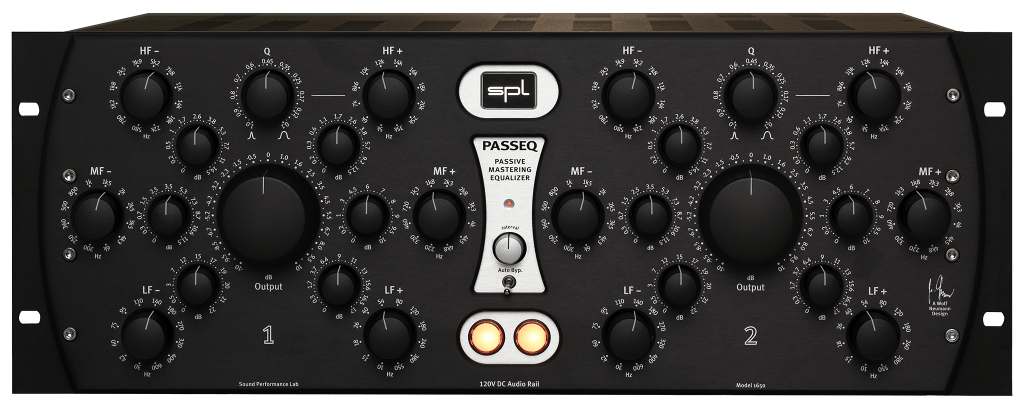
  • SPL PASSEQ 1650 Passive Mastering Equalizer – Black

    SPL PASSEQ 1650 Passive Mastering Equalizer – Black

    Passive Mastering Equalizer

    The new dual-channel PASSEQ (Model 1650/1654) is the resolute evolution of the highly acclaimed predecessor Model 2595.

    The new PASSEQ now features Air band, a stepped output control ranging from -10dB to +10dB and a mid cut band now starting at 200Hz. These features were on the wish list of many mastering engineers.

    Furthermore we have exchanged capacitor arrays in the filters by custom-made single capacitors and optimized the bandwidth per frequency range. This evolution is a sonic revolution.

    The components in a passive filter such a variable resistor, capacitor and coil deliver a special sonic character. An important part of the sound is played by coil and capacitor loading and saturation characteristics. The resulting inertia in contrast to the fast reaction of active filters is the reason for the pleasing sound that we get from passive designs.

    We tend to perceive these attributes in terms of an increased suppleness and transparency, with perceptibly improved, silky highs and warm and punchy basses.

    The first generation Passeq was the first passive equalizer that offered high, mid and low band with individual boost and cut and with 12 selectable frequencies per band. Passeq was the most powerful passive EQ system ever made with a total of 36 boost and 36 cut frequencies. The sheer amount of possible frequency curves or shapes is close to 3 million.

    Now, here is the 2nd generation: the new PASSEQ Mastering Equalizer. It features the same amount of boost and cut frequencies, though the choice of frequencies is altered and the Q-factor is more musically adjusted for each selectable frequency.

    With 72 static filters every channel (36 x Enhance, 36 x Cut), the Passeq exceeds all previous styles of this kind by a wide margin. Each network is divided in to 3 Cut and 3 Boost bands, each providing 12 switchable regularity selections. The Cut and Improvement arrays are not identical; crossovers are made to partner with like an accurate mechanic cogwheel so about enable the engineer accessibility to the biggest possible amount of superior, wide-band S-curves with variable pitches.

    An additional amazing Passeq attribute is its individual sonic adjustment of each inductive filter through different coil/condenser/resistor combos: In stark contrast to earlier filter style and building, each Passeq filter is optimized for the frequency assigned.To guarantee the very best feasible signal heat, exuberance and musicality in processing, coils for important voice regularities are personalized for the Passeq.This attains the widest feasible range and tonally enticing noise shade scheme from any type of passive EQ.

    Inputs

    Max. Input Level: + 32.5 dBu
    Input Inpedance: 20 kOhms (balanced)

    Outputs

    Max. Output Level: + 32.5 dBu
    Output Inpedance: ‹ 600 Ohms (balanced)

    Harmonic Distortion:

    at -30 dBu: 0.076%
    at -20 dBu: 0.026%
    at 0 dBu: 0.026%
    at +10 dBu: 0.0086%
    at +30 dBu: 0.0012%

    Noise (unweighted, (Gain +0 dBu, EQ = 0dB B/C): - 91.8 dBu

    Noise (A-weighted, (Gain +0 dBu, EQ = 0dB B/C): - 95.2 dBu

    Noise CCIR, (Gain +0 dBu, EQ = 0dB B/C): -86.2 dBu

    THD & N (Gain +0 dBu, EQ = 0dB B/C): › 102 dB

    Common-Mode-Rejection: › -60 dBu
    (bei 1 kHz, Gain +0 dBu, EQ = 0dB B/C)

    Transmission Bandwidth (-3 dB):

    10 Hz – 200 kHz

    Frequency Range:

    10 Hz – 35 kHz

    Power Consumption:

    0.06 Amp, 230V/50Hz, 9.5 Watt, 13.6 VA
    0.09 Amp, 115V/60Hz, 9.5 Watt, 13.6  VA

    Fuses:

    230 V/50 Hz: 0.5 Amp
    115 V/60 Hz: 1  Amp

    Dimensions:

    Standard EIA 19 Inch Housing/4U, 482 x 177 x 311.5 mm / ca. 19″ x 7″ x 12,25″

    Weight:

    10.2 kg / 22.5 lb

  • SPL PASSEQ PASSIVE MASTERING EQUALIZER – RED 1654

    SPL PASSEQ PASSIVE MASTERING EQUALIZER – RED 1654

    PASSEQ
    Passive Mastering Equalizer
    The new dual-channel PASSEQ (Model 1650/1654) is the resolute evolution of the highly acclaimed predecessor Model 2595.
    The new PASSEQ now features Air band, a stepped output control ranging from -10dB to +10dB and a mid cut band now starting at 200Hz. These features were on the wish list of many mastering engineers.

    Furthermore we have exchanged capacitor arrays in the filters by custom-made single capacitors and optimized the bandwidth per frequency range. This evolution is a sonic revolution.

  • SPL PERFORMER M1000 – BLACK Mono Power Amplifier

    SPL PERFORMER M1000 – BLACK Mono Power Amplifier

    Performer m1000
    Mono Power Amplifier
    The Performer m1000 is the big brother of the highly acclaimed Performer s800.
    Built as a mono block it features SPL’s proprietary VOLTAiR technology that allows creating power amps with far less components in the signal path than common designs. Only one preamplifier op-amp is required to drive the bipolar power amplifier transistors: extremely fast, direct, highly efficient and with an extraordinary sound.

    The Performer m1000 delivers 1000 W into 2 ohms or 750 W into 4 ohms out of a linear power supply with a massive toroidal transformer.

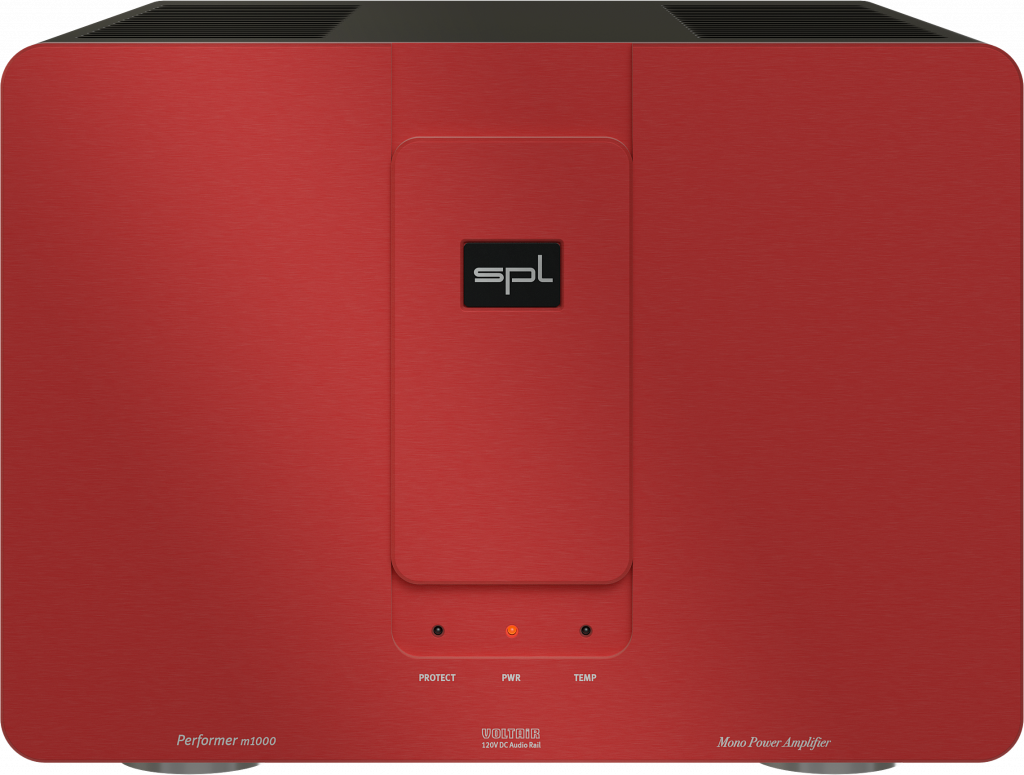
  • SPL PERFORMER M1000 – RED Mono Power Amplifier

    SPL PERFORMER M1000 – RED Mono Power Amplifier

    Performer m1000
    Mono Power Amplifier
    The Performer m1000 is the big brother of the highly acclaimed Performer s800.
    Built as a mono block it features SPL’s proprietary VOLTAiR technology that allows creating power amps with far less components in the signal path than common designs. Only one preamplifier op-amp is required to drive the bipolar power amplifier transistors: extremely fast, direct, highly efficient and with an extraordinary sound.

    The Performer m1000 delivers 1000 W into 2 ohms or 750 W into 4 ohms out of a linear power supply with a massive toroidal transformer.

  • SPL PERFORMER M1000 – SILVER Mono Power Amplifier

    SPL PERFORMER M1000 – SILVER Mono Power Amplifier

    Performer m1000
    Mono Power Amplifier
    The Performer m1000 is the big brother of the highly acclaimed Performer s800.
    Built as a mono block it features SPL’s proprietary VOLTAiR technology that allows creating power amps with far less components in the signal path than common designs. Only one preamplifier op-amp is required to drive the bipolar power amplifier transistors: extremely fast, direct, highly efficient and with an extraordinary sound.

    The Performer m1000 delivers 1000 W into 2 ohms or 750 W into 4 ohms out of a linear power supply with a massive toroidal transformer.

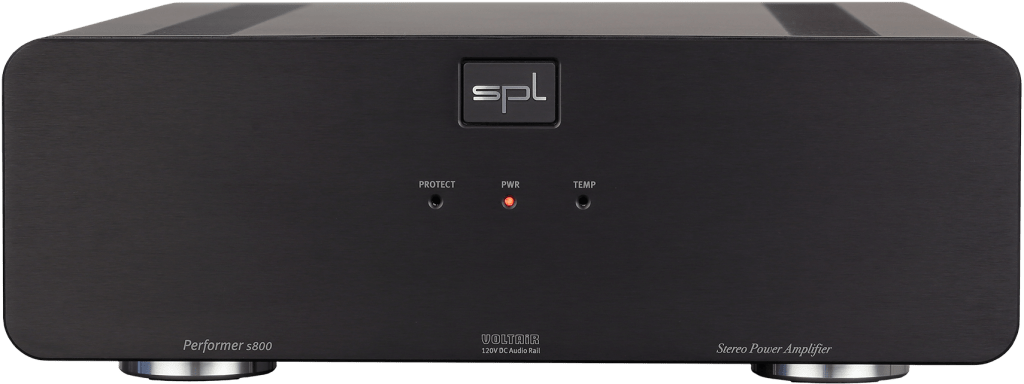
  • SPL PERFORMER S800 Stereo Power Amplifier BLACK

    SPL PERFORMER S800 Stereo Power Amplifier BLACK

    Performer s800
    Stereo Power Amplifier
    Thanks to the VOLTAiR technology the Performer s800 needs far less components in the signal path than common power amplifiers. The preamplifier can directly drive the bipolar power amplifier transistors. Extremely fast, direct, highly efficient and with an extraordinary sound.
    The Performer power amplifier effortlessly controls the speakers with a power of up to 2x 285 W into 4 ohms out of an analog linear power supply with toroidal transformer. In Bridge mode the Performer s800 delivery 450 W into 4 and 8 ohms speakers.

  • SPL PERFORMER S800 Stereo Power Amplifier RED

    SPL PERFORMER S800 Stereo Power Amplifier RED

    Performer s800
    Stereo Power Amplifier
    Thanks to the VOLTAiR technology the Performer s800 needs far less components in the signal path than common power amplifiers. The preamplifier can directly drive the bipolar power amplifier transistors. Extremely fast, direct, highly efficient and with an extraordinary sound.
    The Performer power amplifier effortlessly controls the speakers with a power of up to 2x 285 W into 4 ohms out of an analog linear power supply with toroidal transformer. In Bridge mode the Performer s800 delivery 450 W into 4 and 8 ohms speakers.

  • SPL PERFORMER S800 Stereo Power Amplifier SILVER

    SPL PERFORMER S800 Stereo Power Amplifier SILVER

    Performer s800
    Stereo Power Amplifier
    Thanks to the VOLTAiR technology the Performer s800 needs far less components in the signal path than common power amplifiers. The preamplifier can directly drive the bipolar power amplifier transistors. Extremely fast, direct, highly efficient and with an extraordinary sound.
    The Performer power amplifier effortlessly controls the speakers with a power of up to 2x 285 W into 4 ohms out of an analog linear power supply with toroidal transformer. In Bridge mode the Performer s800 delivery 450 W into 4 and 8 ohms speakers.

  • SPL PHONITOR 2 BLACK – 120V Rail Headphone Monitoring Amplifier

    SPL PHONITOR 2 BLACK – 120V Rail Headphone Monitoring Amplifier

    Phonitor 2

    120V Rail Headphone Monitoring Amplifier

    “It’s really impressive how the Phonitor 2 manages to keep the tone intact even at high pressure sound levels showing no ear fatigue and no problem in unleashing all the dynamics present in the source or in the song you’re listening to.”

    Francesco Donadel Campbell, Headphones and around

    120V Rail Headphone Monitoring Amplifier

    We are uber-happy to introduce the successor of our legendary Phonitor 2 headphone preamp. We have kept all proven features while incorporating some major improvements — as such, the new Phonitor can be used as the ultimate monitor controller and preamp for three different sources. Likewise, we revised the 120V Rail Technology in order for it to perform better, which resulted in our measurement gear being outclassed. Even our creative team got even more creative and came up with a fascinating name: “Phonitor 2”.

    • 120V Rail headphone amplifier, preamplifier and monitor controller
    • For all headphones with impedances >10Ohms (>40Ohms for balanced headphones)*
    • Innovative Phonitor Matrix: speaker-equivalent listening on headphones
    • Laterality control: super-fine balance control
    • Solo L/R, Polarity ø L/R, Mono/Stereo
    • Volume remotely adjustable (learns any IR remote control)
    • Maximum output power: 2 x 2W (1kHz/300Ohm)
    • Frequency response: 4Hz – 480kHz (-3dB)
    • THD+N: 0.00091% (HP), 0.00085% (Line)
    • Dynamic range: 133.62dB (HP), 134.37dB (Line)
    • Made in Germany

    When we brought out the first Phonitor back in 2008, the professional audio world seemed to have been eagerly awaiting it. The success of this unique headphone preamp was overwhelming. It combined a monitoring controller with a headphone amplifier that had provisions that made it possible to reliably mix on headphones. Ever since we call this new species a „Headphone Monitoring Amp,“ which inspired the product name itself: Phonitor.

    Interestingly enough, the Phonitor not only became best friends with thousand of professional users, it also won a lot of fans in the Hi-Fi community.

    But that was by no means a coincidence — ultimately, the Phonitor can be counted among the best headphone preamps in the world thanks to our unique 120V Rail technology. With its exceptional technical specifications and a huge power margin, it can reproduce any musical material without the slightest modification. Hearing fatigue is drastically reduced. Given all that, it was easy to understand the enthusiasm with which musicians, sound engineers and music lovers received the Phonitor worldwide.

    Phonitor 2

    Many Phonitor users told us they wished they could also use the unmatched signal quality that the Phonitor provides to feed their speakers. The Phonitor 2 is a full-fledged stereo preamp that could become the heart of modern professional and home systems alike where headphones have a preeminent importance. Moreover, we have achieved enormous advances with our 120V Rail Technology, making the technical specifications of the Phonitor 2 a new standard in all respects: 141dB dynamic range, 107dB signal-to-noise ratio, -112/-114 dB THD (headphone/speaker output with +30dBu output level). Mind you, the THD measurements define the limits of the measuring equipment but not those of the Phonitor 2.

    The Phonitor 2 remains first and foremost a headphone preamp, which is easy to identify given the elaborate loudspeaker simulation for headphones. It works seamlessly with low-impedance headphones with load impedances as low as 10 Ohm (40 Ohm with balanced headphones).

    If there is the need for more than one stereo speaker set, we recommended to use our passive switcher called the Expansion Rack.

    Remote Control

    To control the volume you can use any IR remote control: the Phonitor 2 learns your remote’s signal.

    Phonitoring: With And Without Magnifiers

    Already for the headphone monitoring – or phonitoring – part alone, the Phonitor 2 encompasses advantages of both kinds of traditional monitoring methods: On one hand the analytical headphone monitoring is like working with an acoustic magnifier but without external room influences; on the other hand, loudspeaker simulation allows for monitoring which  forgoes the microscopic effect, but provides for room ambiance.
    Working with the magnifier effect of headphones has the advantage of safely hearing clicks or similar defects and helps in fine tuning crossfades or to judge tonal problems in individual tracks. On loudspeakers such analyses are much more difficult, as such problems just are not as apparent when one is working without being able to “zoom in” aurally. Conversely, loudspeakers provide monitoring with the advantage of spatial balance in a (definable through placement) stereo width, which in turn provides the illusion of an acoustic stage.
    Traditional headphone reproduction produces one 180-degree stereo width in the middle of the head, and it is exactly this which creates the very problematic-to-impossible headphone mixing environment. An essential reason for such unnatural ambiance is the complete separation of the channels, which does not exist either in natural hearing or in stereo loudspeaker reproduction. This makes it nearly impossible to judge tonal balance, a stereo image and the phantom center level. Panorama adjustments as well as related EQ settings that one attempts with headphones, typically just do not function on loudspeakers.
    Moreover, what is often called the “super stereo effect” with headphones usually creates a great deal of ear fatigue in the long run. Over loudspeakers the sound stage is felt in front, while in contrast, when monitoring through headphones, the stage is present on the left and on the right – but frontal and rear information is lost.

    The End Of Ear Fatigue

    Aside from these unnatural headphone ambiance there are further disadvantages with fatigue when mixing or listening with headphones. First, some cans themselves may not be that comfortable to wear …

    Moreover, a standard headphone amplifier is often an additional important reason for premature ear fatigue. Almost without exception, present-day headphone amplifiers employ comparatively undemanding IC’s. In the best cases they might work with symmetrical voltages of +/-15V to +/-18V, and in less favorable cases, with only a simple supply of 9 or 12V from cheaper external “wall-wart“ power supplies.

    But the voltage level acts in circuitry much like the cubic inch capacity to the productive power of a combustion engine: Cubic inch capacity is replaceable with nothing but more cubic inch capacity – and in the productive power of electronics, voltage level functions similarly.
    For some years, now, SPL has addressed this issue in all of its mastering product series through its own specifically developed 120 volt technology. Consoles and signal processors of the SPL Mastering Series appear as central elements in installations of today’s most renowned mastering houses (for example Bob Ludwig’s Gateway Mastering & DVD in the USA, Simon Heyworth’s Super Audio Mastering in Great Britain, the Galaxy Studios in Belgium and the legendary Wisseloord in the Netherlands). This 120 volt technology is based on discrete operation amplifiers from SPL’s own production, developed and perfected over many years by SPL’s co-founder and chief developer, Wolfgang Neumann. These OPs work with high-performance semiconductors in Class A technology at a symmetrical voltage of +/-60V.

    The Phonitor 2 is the first unit to employ the 2nd generation of our 120V OPs with improved specifications once again. They have Signal To Noise Ratio of 116dB and offer a nearly 34dB headroom – that yields an unequalled 150dB dynamic range.

    The musical result is not to be mistaken: Regardless of the monitoring means, regardless of how loud you monitor – the Phonitor 2 always remains a distant, impartial factor unaffected when used to capacity and beyond being overloaded. The phase stability is always perfect, its THD next to immeasurable.

    The Phonitor 2’s OPs cannot be stressed in the most stressful circumstances, and for precisely this reason its musical sound is always relaxed and spacious. All frequencies are reproduced in balance, basses are stable and tight, mids are clear and differentiated and highs remain transparent and soft. Particularly striking is the fact that you can easily listen to every detail. Hearing fatigue makes it usually harder to carefully listen to and understand complex signals over a long period of time. The Phonitor 2 reverses this situation turning it into a pleasant listening experience that leaves you longing for more.

    Applications

    • Stereo preamplification and headphone amplification for three sources
    • High-quality music playback at home
    • Central monitoring unit in professional environments with all classic features like phase reverse, solo, mono
    • Re-Amping (for example, level boost after analog master processing)
    • Headphone amplifier for all headphone systems and impedances
    • Loudspeaker simulation with headphones
    • Monitoring alternative in studios and mobile units
    • Adjustment of headphone playback to match familiar monitor speakers
    • Mobile reproduction of usual monitoring conditions

    120V Rail Technology is our reference technology developed and manufactured to run on an operating voltage of 120 volts, which corresponds to twice that of discrete operational amplifiers and four-times that of semiconductor operational amplifiers.

    120V Rail Technology reaches outstanding technical and sonic performances. Technically especially in terms of dynamic range and headroom and sonically especially in reproducing the finest details and delivering a totally relaxed sounding audio experience. Music sounds absolutely natural and hearing fatigue is drastically reduced.

    Even the best audio measuring equipment arrives at the boundaries. In same situations we ended up just measuring the Audio Precision Cascade 2 measuring device and we cannot say how good the 120V Rail Technology actually performs.

    Comparisons

    These diagrams show how our 120V Rail Technology compares to other circuits.


    The direct relation between operating level and maximum level is fundamental for the classification: the higher the operating level, the higher the maximum level a circuit can handle. And since virtually all essential acoustic and musical parameters depend on this relation, a higher operating voltage also has a positive impact on the dynamic range, distortion limit and signal-to-noise ratio.


    Do bear in mind that dB scales do not represent linear but rather exponential increases. A 3dB increase corresponds to doubling the acoustic power, +6dB correspond to twice the sound pressure level, and +10dB correspond to twice the perceived loudness.

    When it comes to volume, the 120V Rail Technology exhibits a performance, in regard to maximum level and dynamic range, that is twice that of common components and circuits given that its values are approximately 10dB higher.


    THD measurements of the 120V op-amp show a difference of more than 3dB compared to the OPA134 at 36V — in terms of sound pressure level, that corresponds to an improvement of more than 50%.

    The operating level most commonly used for audio equipment is 30 volts.


    The 120V Rail Op-Amp Generations

  • SPL PHONITOR 2 SILVER – 120V Rail Headphone Monitoring Amplifier

    SPL PHONITOR 2 SILVER – 120V Rail Headphone Monitoring Amplifier

    Phonitor 2

    120V Rail Headphone Monitoring Amplifier

    “It’s really impressive how the Phonitor 2 manages to keep the tone intact even at high pressure sound levels showing no ear fatigue and no problem in unleashing all the dynamics present in the source or in the song you’re listening to.”

    Francesco Donadel Campbell, Headphones and around

    120V Rail Headphone Monitoring Amplifier

    We are uber-happy to introduce the successor of our legendary Phonitor 2 headphone preamp. We have kept all proven features while incorporating some major improvements — as such, the new Phonitor can be used as the ultimate monitor controller and preamp for three different sources. Likewise, we revised the 120V Rail Technology in order for it to perform better, which resulted in our measurement gear being outclassed. Even our creative team got even more creative and came up with a fascinating name: “Phonitor 2”.

    • 120V Rail headphone amplifier, preamplifier and monitor controller
    • For all headphones with impedances >10Ohms (>40Ohms for balanced headphones)*
    • Innovative Phonitor Matrix: speaker-equivalent listening on headphones
    • Laterality control: super-fine balance control
    • Solo L/R, Polarity ø L/R, Mono/Stereo
    • Volume remotely adjustable (learns any IR remote control)
    • Maximum output power: 2 x 2W (1kHz/300Ohm)
    • Frequency response: 4Hz – 480kHz (-3dB)
    • THD+N: 0.00091% (HP), 0.00085% (Line)
    • Dynamic range: 133.62dB (HP), 134.37dB (Line)
    • Made in Germany

    When we brought out the first Phonitor back in 2008, the professional audio world seemed to have been eagerly awaiting it. The success of this unique headphone preamp was overwhelming. It combined a monitoring controller with a headphone amplifier that had provisions that made it possible to reliably mix on headphones. Ever since we call this new species a „Headphone Monitoring Amp,“ which inspired the product name itself: Phonitor.

    Interestingly enough, the Phonitor not only became best friends with thousand of professional users, it also won a lot of fans in the Hi-Fi community.

    But that was by no means a coincidence — ultimately, the Phonitor can be counted among the best headphone preamps in the world thanks to our unique 120V Rail technology. With its exceptional technical specifications and a huge power margin, it can reproduce any musical material without the slightest modification. Hearing fatigue is drastically reduced. Given all that, it was easy to understand the enthusiasm with which musicians, sound engineers and music lovers received the Phonitor worldwide.

    Phonitor 2

    Many Phonitor users told us they wished they could also use the unmatched signal quality that the Phonitor provides to feed their speakers. The Phonitor 2 is a full-fledged stereo preamp that could become the heart of modern professional and home systems alike where headphones have a preeminent importance. Moreover, we have achieved enormous advances with our 120V Rail Technology, making the technical specifications of the Phonitor 2 a new standard in all respects: 141dB dynamic range, 107dB signal-to-noise ratio, -112/-114 dB THD (headphone/speaker output with +30dBu output level). Mind you, the THD measurements define the limits of the measuring equipment but not those of the Phonitor 2.

    The Phonitor 2 remains first and foremost a headphone preamp, which is easy to identify given the elaborate loudspeaker simulation for headphones. It works seamlessly with low-impedance headphones with load impedances as low as 10 Ohm (40 Ohm with balanced headphones).

    If there is the need for more than one stereo speaker set, we recommended to use our passive switcher called the Expansion Rack.

    Remote Control

    To control the volume you can use any IR remote control: the Phonitor 2 learns your remote’s signal.

    Phonitoring: With And Without Magnifiers

    Already for the headphone monitoring – or phonitoring – part alone, the Phonitor 2 encompasses advantages of both kinds of traditional monitoring methods: On one hand the analytical headphone monitoring is like working with an acoustic magnifier but without external room influences; on the other hand, loudspeaker simulation allows for monitoring which  forgoes the microscopic effect, but provides for room ambiance.
    Working with the magnifier effect of headphones has the advantage of safely hearing clicks or similar defects and helps in fine tuning crossfades or to judge tonal problems in individual tracks. On loudspeakers such analyses are much more difficult, as such problems just are not as apparent when one is working without being able to “zoom in” aurally. Conversely, loudspeakers provide monitoring with the advantage of spatial balance in a (definable through placement) stereo width, which in turn provides the illusion of an acoustic stage.
    Traditional headphone reproduction produces one 180-degree stereo width in the middle of the head, and it is exactly this which creates the very problematic-to-impossible headphone mixing environment. An essential reason for such unnatural ambiance is the complete separation of the channels, which does not exist either in natural hearing or in stereo loudspeaker reproduction. This makes it nearly impossible to judge tonal balance, a stereo image and the phantom center level. Panorama adjustments as well as related EQ settings that one attempts with headphones, typically just do not function on loudspeakers.
    Moreover, what is often called the “super stereo effect” with headphones usually creates a great deal of ear fatigue in the long run. Over loudspeakers the sound stage is felt in front, while in contrast, when monitoring through headphones, the stage is present on the left and on the right – but frontal and rear information is lost.

    The End Of Ear Fatigue

    Aside from these unnatural headphone ambiance there are further disadvantages with fatigue when mixing or listening with headphones. First, some cans themselves may not be that comfortable to wear …

    Moreover, a standard headphone amplifier is often an additional important reason for premature ear fatigue. Almost without exception, present-day headphone amplifiers employ comparatively undemanding IC’s. In the best cases they might work with symmetrical voltages of +/-15V to +/-18V, and in less favorable cases, with only a simple supply of 9 or 12V from cheaper external “wall-wart“ power supplies.

    But the voltage level acts in circuitry much like the cubic inch capacity to the productive power of a combustion engine: Cubic inch capacity is replaceable with nothing but more cubic inch capacity – and in the productive power of electronics, voltage level functions similarly.
    For some years, now, SPL has addressed this issue in all of its mastering product series through its own specifically developed 120 volt technology. Consoles and signal processors of the SPL Mastering Series appear as central elements in installations of today’s most renowned mastering houses (for example Bob Ludwig’s Gateway Mastering & DVD in the USA, Simon Heyworth’s Super Audio Mastering in Great Britain, the Galaxy Studios in Belgium and the legendary Wisseloord in the Netherlands). This 120 volt technology is based on discrete operation amplifiers from SPL’s own production, developed and perfected over many years by SPL’s co-founder and chief developer, Wolfgang Neumann. These OPs work with high-performance semiconductors in Class A technology at a symmetrical voltage of +/-60V.

    The Phonitor 2 is the first unit to employ the 2nd generation of our 120V OPs with improved specifications once again. They have Signal To Noise Ratio of 116dB and offer a nearly 34dB headroom – that yields an unequalled 150dB dynamic range.

    The musical result is not to be mistaken: Regardless of the monitoring means, regardless of how loud you monitor – the Phonitor 2 always remains a distant, impartial factor unaffected when used to capacity and beyond being overloaded. The phase stability is always perfect, its THD next to immeasurable.

    The Phonitor 2’s OPs cannot be stressed in the most stressful circumstances, and for precisely this reason its musical sound is always relaxed and spacious. All frequencies are reproduced in balance, basses are stable and tight, mids are clear and differentiated and highs remain transparent and soft. Particularly striking is the fact that you can easily listen to every detail. Hearing fatigue makes it usually harder to carefully listen to and understand complex signals over a long period of time. The Phonitor 2 reverses this situation turning it into a pleasant listening experience that leaves you longing for more.

    Applications

    • Stereo preamplification and headphone amplification for three sources
    • High-quality music playback at home
    • Central monitoring unit in professional environments with all classic features like phase reverse, solo, mono
    • Re-Amping (for example, level boost after analog master processing)
    • Headphone amplifier for all headphone systems and impedances
    • Loudspeaker simulation with headphones
    • Monitoring alternative in studios and mobile units
    • Adjustment of headphone playback to match familiar monitor speakers
    • Mobile reproduction of usual monitoring conditions

    120V Rail Technology is our reference technology developed and manufactured to run on an operating voltage of 120 volts, which corresponds to twice that of discrete operational amplifiers and four-times that of semiconductor operational amplifiers.

    120V Rail Technology reaches outstanding technical and sonic performances. Technically especially in terms of dynamic range and headroom and sonically especially in reproducing the finest details and delivering a totally relaxed sounding audio experience. Music sounds absolutely natural and hearing fatigue is drastically reduced.

    Even the best audio measuring equipment arrives at the boundaries. In same situations we ended up just measuring the Audio Precision Cascade 2 measuring device and we cannot say how good the 120V Rail Technology actually performs.

    Comparisons

    These diagrams show how our 120V Rail Technology compares to other circuits.


    The direct relation between operating level and maximum level is fundamental for the classification: the higher the operating level, the higher the maximum level a circuit can handle. And since virtually all essential acoustic and musical parameters depend on this relation, a higher operating voltage also has a positive impact on the dynamic range, distortion limit and signal-to-noise ratio.


    Do bear in mind that dB scales do not represent linear but rather exponential increases. A 3dB increase corresponds to doubling the acoustic power, +6dB correspond to twice the sound pressure level, and +10dB correspond to twice the perceived loudness.

    When it comes to volume, the 120V Rail Technology exhibits a performance, in regard to maximum level and dynamic range, that is twice that of common components and circuits given that its values are approximately 10dB higher.


    THD measurements of the 120V op-amp show a difference of more than 3dB compared to the OPA134 at 36V — in terms of sound pressure level, that corresponds to an improvement of more than 50%.

    The operating level most commonly used for audio equipment is 30 volts.


    The 120V Rail Op-Amp Generations

  • SPL PHONITOR E – Headphone Amplifier – BLACK

    SPL PHONITOR E – Headphone Amplifier – BLACK

    Phonitor e
    Headphone Amplifier
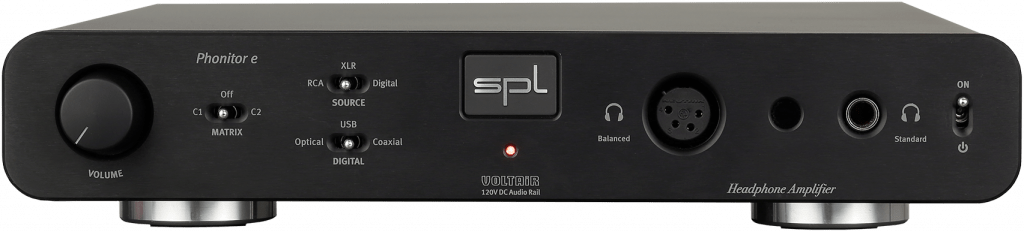
    Our Phonitor headphone amplifiers found a huge fan base among Hi-Fi enthusiasts. The Phonitor e comprises the most essential functions and features in a slim and beautiful housing.
    The Phonitor e offers connections for headphone operated both balanced and unbalanced. With up to 3.7 W output power it delivers an impressive performance.

    The Phonitor Matrix is also part of the Phonitor e and it lets you experience music on headphones as if you are listening to speakers.

  • SPL PHONITOR E – Headphone Amplifier – RED

    SPL PHONITOR E – Headphone Amplifier – RED

    Phonitor e
    Headphone Amplifier
    Our Phonitor headphone amplifiers found a huge fan base among Hi-Fi enthusiasts. The Phonitor e comprises the most essential functions and features in a slim and beautiful housing.
    The Phonitor e offers connections for headphone operated both balanced and unbalanced. With up to 3.7 W output power it delivers an impressive performance.

    The Phonitor Matrix is also part of the Phonitor e and it lets you experience music on headphones as if you are listening to speakers.

  • SPL PHONITOR E – Headphone Amplifier – RED + DAC

    SPL PHONITOR E – Headphone Amplifier – RED + DAC

    Phonitor e
    Headphone Amplifier
    Our Phonitor headphone amplifiers found a huge fan base among Hi-Fi enthusiasts. The Phonitor e comprises the most essential functions and features in a slim and beautiful housing.
    The Phonitor e offers connections for headphone operated both balanced and unbalanced. With up to 3.7 W output power it delivers an impressive performance.

    The Phonitor Matrix is also part of the Phonitor e and it lets you experience music on headphones as if you are listening to speakers. equipped with the DAC192 DA-converter. With that installed the available inputs are expanded by USB, coaxial and optical digital stereo inputs. The DA converter supports sample rates up to 192 kHz with 24 bit. It syncs automatically to the sample rate of the selected digital input.

  • SPL PHONITOR E – Headphone Amplifier – SILVER

    SPL PHONITOR E – Headphone Amplifier – SILVER

    Phonitor e
    Headphone Amplifier
    Our Phonitor headphone amplifiers found a huge fan base among Hi-Fi enthusiasts. The Phonitor e comprises the most essential functions and features in a slim and beautiful housing.
    The Phonitor e offers connections for headphone operated both balanced and unbalanced. With up to 3.7 W output power it delivers an impressive performance.

    The Phonitor Matrix is also part of the Phonitor e and it lets you experience music on headphones as if you are listening to speakers.

  • SPL PHONITOR E – Headphone Amplifier – SILVER + DAC

    SPL PHONITOR E – Headphone Amplifier – SILVER + DAC

    Phonitor e
    Headphone Amplifier
    Our Phonitor headphone amplifiers found a huge fan base among Hi-Fi enthusiasts. The Phonitor e comprises the most essential functions and features in a slim and beautiful housing.
    The Phonitor e offers connections for headphone operated both balanced and unbalanced. With up to 3.7 W output power it delivers an impressive performance.

    The Phonitor Matrix is also part of the Phonitor e and it lets you experience music on headphones as if you are listening to speakers. equipped with the DAC192 DA-converter. With that installed the available inputs are expanded by USB, coaxial and optical digital stereo inputs. The DA converter supports sample rates up to 192 kHz with 24 bit. It syncs automatically to the sample rate of the selected digital input.

  • SPL PHONITOR E – Headphone Amplifier- BLACK + DAC

    SPL PHONITOR E – Headphone Amplifier- BLACK + DAC

    Phonitor e
    Headphone Amplifier
    Our Phonitor headphone amplifiers found a huge fan base among Hi-Fi enthusiasts. The Phonitor e comprises the most essential functions and features in a slim and beautiful housing.
    The Phonitor e offers connections for headphone operated both balanced and unbalanced. With up to 3.7 W output power it delivers an impressive performance.

    The Phonitor Matrix is also part of the Phonitor e and it lets you experience music on headphones as if you are listening to speakers. equipped with the DAC192 DA-converter. With that installed the available inputs are expanded by USB, coaxial and optical digital stereo inputs. The DA converter supports sample rates up to 192 kHz with 24 bit. It syncs automatically to the sample rate of the selected digital input.