Expansion Rack
19″-Rackmount with passive 4-way stereo output
The Expansion Rack allows for mounting the Phonitor 2 and the SMC 7.1 in a 19″-Rack. Additionally the built-in 1×4 Switch expands offer connectivity for up to four stereo speaker sets.
Brand: SPL
-
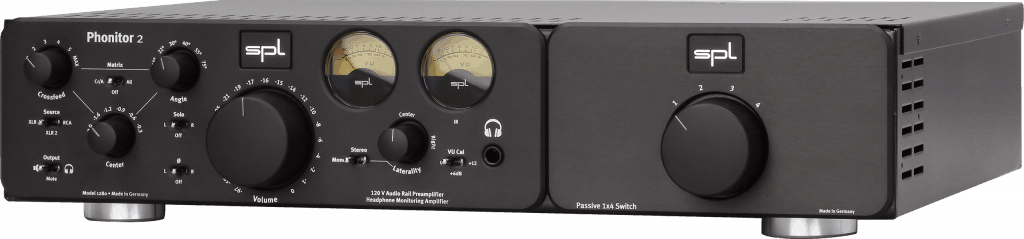
SPL EXPANSION RACK BLACK – 19″-Rackmount with passive 4-way stereo output
-

SPL EXPANSION RACK SILVER – 1531 Rack-mount housing for the Phonitor 2 B-Stock
Includes Full Warranty As New, from Manufacturer
Expansion Rack
19″-Rackmount with passive 4-way stereo output
The Expansion Rack allows for mounting the Phonitor 2 and the SMC 7.1 in a 19″-Rack. Additionally the built-in 1×4 Switch expands offer connectivity for up to four stereo speaker sets. -
SPL EXPANSION RACK SILVER – 19″-Rackmount with passive 4-way stereo output
Expansion Rack
19″-Rackmount with passive 4-way stereo output
The Expansion Rack allows for mounting the Phonitor 2 and the SMC 7.1 in a 19″-Rack. Additionally the built-in 1×4 Switch expands offer connectivity for up to four stereo speaker sets. -

SPL FRONTLINER – 2800 Channel Strip / Processing Unit B-Stock
Includes Full Warranty As New, from Manufacturer
Frontliner
The flagship channel strip.
The Frontliner has all tools on board to record vocals and instruments in perfect quality: it merges a preamp, a de-esser, an EQ, a compressor and tube saturation.
Thanks to it’s individual analog I/Os, all these powerful, hi-end analog processors can be use not only while recording but also during mixing. The Frontliner is therefore not reduced to a front-end device. Especially DAW based studios can integrate high-grade analog processing at any stage of the audio production process.
This version of the SPL Frontliner channel strip boasts the same impressive functionality of the standard Frontliner, and it adds a two-channel A/D converter with 24-bit/192kHz resolution for more connectivity options. Its modular nature, with individual analog ins and outs for the preamp, de-esser, compressor/limiter, and EQ/tube saturation sections, means the Frontliner also represents four outstanding hardware processors in one. The rich, clear sound is ideal for everything from music recording to voiceovers and broadcast. Capture polished recordings on the way in, then take advantage of four world-class analog processors during mixdown with the SPL Frontliner modular channel strip.
SPL Frontliner Channel Strip at a Glance:
- Top-shelf components and design for outstanding sound
- Built-in 2-channel A/D converter for more routing options
- A versatile front end for agile studio performance
- Easily fits into your studio
Top-shelf components and design for outstanding sound
Time to get geeky: the SPL Frontliner boasts a discrete semiconductor/tube hybrid preamplifier that combines the best characteristics of solid-state and tube preamp technologies. You get the high dynamic range and low-noise operation of semiconductor-based preamps, with the appealing highs and beautiful spatial impression that tubes provide. The preamp and tube saturation stages of the Frontliner operate at 250 volts for ample headroom and excellent transient response. Renowned Burr-Brown op-amps are used to regulate voltage throughout the signal path. Even the wiring follows a central-star grounding scheme that minimizes electrical noise and interference. From input to output, the SPL Frontliner has obviously been designed by engineers who know how world-class sound quality is achieved.
Built-in 2-channel A/D converter for more routing options
This Frontliner is equipped with the optional analog to digital converter right out of the box. This allows you to send the output of the Frontliner digitally into your recording system, and it also effectively turns your Frontliner into a two-input front end: just plug any line-level signal into the AD Input on the back panel. While you may not use it on every session, at some point you will find yourself in a routing situation where the additional A/D capabilities on this Frontliner get you out of a jam. Digital outputs include S/PDIF and optical, with sync available via a dedicated S/PDIF input.
- Modular channel strip with preamp, de-esser, comp/limiter, and EQ/tube saturation sections
- Built-in 2-channel A/D converter for digital connectivity (S/PDIF, optical)
- Excellent dynamic range and low-noise performance from the discrete solid-state/tube hybrid preamp design
- Individual analog I/O for each section allows you to use processors separately during mixdown
- Auto-mode on the compressor can still be influenced by the attack/release controls for fine-tuned response
- Dual outputs allow you to feed 2 destinations simultaneously, for example a front of house mixing board and a monitor mixer for live performance
- Tube +15dB switch increases the degree of tube amplification for enhanced harmonic richness
- A great workhorse solution for project studios, pro studios, and broadcast
- Top-shelf components and circuit design for outstanding sonic quality
Record and mix better tracks with the SPL Frontliner modular channel strip!
Tech Specs
Preamp Type Tube/Solid-state hybrid Number of Channels 1 Frequency Response 10Hz-50kHz Phantom Power Yes EQ Yes Compressor Yes Other Processing De-Esser, Tube Saturation Analog Inputs 5 x XLR, 1 x Inst Analog Outputs 6 x XLR Digital Outputs 1 x S/PDIF, 1 x optical Other I/O 1 x Sync (S/PDIF) Manufacturer Part Number 28000001 -
SPL FRONTLINER – Modular Channel Strip with Hybrid Tube Preamp
Frontliner
The flagship channel strip.
The Frontliner has all tools on board to record vocals and instruments in perfect quality: it merges a preamp, a de-esser, an EQ, a compressor and tube saturation.
Thanks to it’s individual analog I/Os, all these powerful, hi-end analog processors can be use not only while recording but also during mixing. The Frontliner is therefore not reduced to a front-end device. Especially DAW based studios can integrate high-grade analog processing at any stage of the audio production process.
This version of the SPL Frontliner channel strip boasts the same impressive functionality of the standard Frontliner, and it adds a two-channel A/D converter with 24-bit/192kHz resolution for more connectivity options. Its modular nature, with individual analog ins and outs for the preamp, de-esser, compressor/limiter, and EQ/tube saturation sections, means the Frontliner also represents four outstanding hardware processors in one. The rich, clear sound is ideal for everything from music recording to voiceovers and broadcast. Capture polished recordings on the way in, then take advantage of four world-class analog processors during mixdown with the SPL Frontliner modular channel strip.
SPL Frontliner Channel Strip at a Glance:
- Top-shelf components and design for outstanding sound
- Built-in 2-channel A/D converter for more routing options
- A versatile front end for agile studio performance
- Easily fits into your studio
Top-shelf components and design for outstanding sound
Time to get geeky: the SPL Frontliner boasts a discrete semiconductor/tube hybrid preamplifier that combines the best characteristics of solid-state and tube preamp technologies. You get the high dynamic range and low-noise operation of semiconductor-based preamps, with the appealing highs and beautiful spatial impression that tubes provide. The preamp and tube saturation stages of the Frontliner operate at 250 volts for ample headroom and excellent transient response. Renowned Burr-Brown op-amps are used to regulate voltage throughout the signal path. Even the wiring follows a central-star grounding scheme that minimizes electrical noise and interference. From input to output, the SPL Frontliner has obviously been designed by engineers who know how world-class sound quality is achieved.
Built-in 2-channel A/D converter for more routing options
This Frontliner is equipped with the optional analog to digital converter right out of the box. This allows you to send the output of the Frontliner digitally into your recording system, and it also effectively turns your Frontliner into a two-input front end: just plug any line-level signal into the AD Input on the back panel. While you may not use it on every session, at some point you will find yourself in a routing situation where the additional A/D capabilities on this Frontliner get you out of a jam. Digital outputs include S/PDIF and optical, with sync available via a dedicated S/PDIF input.
- Modular channel strip with preamp, de-esser, comp/limiter, and EQ/tube saturation sections
- Built-in 2-channel A/D converter for digital connectivity (S/PDIF, optical)
- Excellent dynamic range and low-noise performance from the discrete solid-state/tube hybrid preamp design
- Individual analog I/O for each section allows you to use processors separately during mixdown
- Auto-mode on the compressor can still be influenced by the attack/release controls for fine-tuned response
- Dual outputs allow you to feed 2 destinations simultaneously, for example a front of house mixing board and a monitor mixer for live performance
- Tube +15dB switch increases the degree of tube amplification for enhanced harmonic richness
- A great workhorse solution for project studios, pro studios, and broadcast
- Top-shelf components and circuit design for outstanding sonic quality
Record and mix better tracks with the SPL Frontliner modular channel strip!
Tech Specs
Preamp Type Tube/Solid-state hybrid Number of Channels 1 Frequency Response 10Hz-50kHz Phantom Power Yes EQ Yes Compressor Yes Other Processing De-Esser, Tube Saturation Analog Inputs 5 x XLR, 1 x Inst Analog Outputs 6 x XLR Digital Outputs 1 x S/PDIF, 1 x optical Other I/O 1 x Sync (S/PDIF) Manufacturer Part Number 28000001 -

SPL FRONTLINER AD – 28000001 Channel Strip with Digital Output B-Stock
Includes Full Warranty As New, from Manufacturer
Frontliner
The flagship channel strip.
The Frontliner has all tools on board to record vocals and instruments in perfect quality: it merges a preamp, a de-esser, an EQ, a compressor and tube saturation.
Thanks to it’s individual analog I/Os, all these powerful, hi-end analog processors can be use not only while recording but also during mixing. The Frontliner is therefore not reduced to a front-end device. Especially DAW based studios can integrate high-grade analog processing at any stage of the audio production process. -
SPL FRONTLINER AD – AD Channel Strip with Digital Output
Frontliner
The flagship channel strip.
The Frontliner has all tools on board to record vocals and instruments in perfect quality: it merges a preamp, a de-esser, an EQ, a compressor and tube saturation.
Thanks to it’s individual analog I/Os, all these powerful, hi-end analog processors can be use not only while recording but also during mixing. The Frontliner is therefore not reduced to a front-end device. Especially DAW based studios can integrate high-grade analog processing at any stage of the audio production process. -

SPL GAINSTATION 1 Single Channel Mic & Instrument Preamp
GainStation 1
Microphone and Instrument Preamplifier
The GainStation 1 is a single channel high-end preamplifier featuring a 60V audio rail.
This preamplifier combines Class-A Clean Gain with sound-shaping Tube Gain in a compact design that allows for free placing close to the microphone or on top of an amplifier.
Modern audio production relies increasingly on digital systems for recording and mixing processes (DAW’s, digital consoles etc.). But still digital systems do not offer the same audio qualities and sound characteristics of high-end analog equipment. Especially digital equalizers and other aspects of the mixing domain cannot compete with the open, transparent sound of the best analog gear. So today more than ever, your input signal has to sound as good as possible—the quality of your original tracks will largely define the end result.
Attacking this problem on the preamplification front, with the goal of noticeably improving a signal and sending it along its path with a healthy foundation, requires a great deal of thought and engineering effort – like with the GainStation 1.
Its very compact design allows for free placing also outside of a rack (e. g. close to the microphone). Musicians can place the GainStation 1 easily on a rack or amplifier.
To accommodate portability, the optionally available SPL GainBag ensures safe transport of the GainStation 1 and offers additional storage for cables and an average-sized microphone. For more permanent installations, up to four GainStation 1’s can be rack-mounted in one optionally available 3-unit mounting frame.Most Notable Features
- Separated Solid state and tube preamps. The tube preamp can be used additionally to the solid state stage to add tube saturations, for clean recordings it can be switched off.
- Peak/FET Limiter
- Switchable Mic Input Impedance (200 Ohms, 1,2 & 10 kOhms)
- Custom-designed and built, fully discrete, class A op-amps (no off-the-shelf stuff here). The GainStation’s op-amps feature 60-Volt operating voltage—twice as high as most common op-amps—for an incredible dynamic range.
- All switching functions are handled by encapsulated relays with gold-plated contacts.
- A no-compromise power supply with extensive additional shielding and seven separately wound and regulated voltages
- Internal 24/192 AD converter, Lundahl input transformer, SPL GainBag and rack mounting frame optionally available
In our humble opinion, the time and energy invested in the development of the GainStation 1 was well worth it. The result is an extremely compact, unusually flexible preamplifier that delivers audio quality usually found only in units costing much more. We believe we just may have set a new record in the sound per cubic centimeter category.
-

SPL GAINSTATION 1AD – Microphone and Instrument Preamplifier
GainStation 1
Microphone and Instrument Preamplifier
The GainStation 1 is a single channel high-end preamplifier featuring a 60V audio rail.
This preamplifier combines Class-A Clean Gain with sound-shaping Tube Gain in a compact design that allows for free placing close to the microphone or on top of an amplifier.
The SPL GainStation 1 AD is a single channel microphone and instrument preamplifier with peak limiting and A/D converter.
Modern audio production relies increasingly on digital systems for recording and mixing processes (DAW’s, digital consoles etc.). But still digital systems do not offer the same audio qualities and sound characteristics of high-end analog equipment. Especially digital equalizers and other aspects of the mixing domain cannot compete with the open, transparent sound of the best analog gear. So today more than ever, your input signal has to sound as good as possible—the quality of your original tracks will largely define the end result.
Attacking this problem on the preamplification front, with the goal of noticeably improving a signal and sending it along its path with a healthy foundation, requires a great deal of thought and engineering effort – like with the GainStation 1.
Its very compact design allows for free placing also outside of a rack (e. g. close to the microphone). Musicians can place the GainStation 1 easily on a rack or amplifier.
To accommodate portability, the optionally available SPL GainBag ensures safe transport of the GainStation 1 and offers additional storage for cables and an average-sized microphone. For more permanent installations, up to four GainStation 1’s can be rack-mounted in one optionally available 3-unit mounting frame.Features
- Separated Solid state and tube preamps. The tube preamp can be used additionally to the solid state stage to add tube saturations, for clean recordings it can be switched off.
- Peak/FET Limiter
- Switchable Mic Input Impedance (200 Ohms, 1,2 & 10 kOhms)
- Custom-designed and built, fully discrete, class A op-amps (no off-the-shelf stuff here). The GainStation’s op-amps feature 60-Volt operating voltage—twice as high as most common op-amps—for an incredible dynamic range.
- All switching functions are handled by encapsulated relays with gold-plated contacts.
- A no-compromise power supply with extensive additional shielding and seven separately wound and regulated voltages
- Internal 24/192 AD converter, Lundahl input transformer, SPL GainBag and rack mounting frame optionally available
In our humble opinion, the time and energy invested in the development of the GainStation 1 was well worth it. The result is an extremely compact, unusually flexible preamplifier that delivers audio quality usually found only in units costing much more. We believe we just may have set a new record in the sound per cubic centimeter category.
Technical Specifications
Frequency response: ‹1Hz-125kHz
(Clean Gain 30dB, Tube Gain off, output level 0dB, +/- 0.5dB)Frequency response: ‹1Hz-310kHz
(Clean Gain 30dB, Tube Gain off, output level 0dB, +/- 3dB)Frequency response: ‹1Hz-125kHz
(Clean Gain 30dB, Tube Gain 1dB, output level 0dB, +/- 0.5dB)THD+N: 0.0005%
(Clean Gain 24dB, Tube Gain off, output level +6dB, 20-22kHz, +25dBu out)THD+N: 0.032%
(Clean Gain 23dB, Tube Gain 1dB, output level +6dB, 20-22kHz, +25dBu out)Noise: -95.4dBu
(Clean Gain 10dB, Tube Gain off, output level 0dB, 20-22kHz, A-weighted)Noise: -91.8dBu
(Clean Gain 30dB, Tube Gain off, output level 0dB, 20-22kHz, A-weighted)Noise: -67.2dBu
(Clean Gain 60dB, Tube Gain off, output level 0dB, 20-22kHz, A-weighted)Noise: -86.4dBu
(Clean Gain 20dB, Tube Gain 10dB, output level 0dB, 20-22kHz, A-weighted)EIN: 127.2dB
(Clean Gain 60dB, Tube Gain off, output level 0dB, 20-22kHz, A-weighted, 40Ohm)Dynamic response: ›130dB
(20-22kHz, A-weighted)Common Mode Rejection: ›80dB
(Clean Gain 30dB, Tube Gain off, 1kHz, Input -30dBu, output level 0, w/o transformer)Maximum Output Level: +34dBu
Max. Input Level (Mic Input, Hi-Z Input): +17dBu
Input Impedance (Instrument input): ›1MOhm
Output impedance: ›75Ohm
Slew Rate: ›40V/µs
(Clean Gain 30dB, Tube Gain off, Output Level +6dB)Phantom power: 48V +/-2V
Power consumption (w/o AD converter): 25W
-

SPL GAINSTATION 8 MK2 – 1180 8-Channel Class A Tube Preamplifier B-Stock
Includes Full Warranty As New, from Manufacturer
GainStation 8 Mk2
8 Channel Microphone and Instrument Preamplifier
The GainStation 8 Mk2 is the premium recording front end featuring 60V audio rail.
This preamplifier combines Class-A Clean Gain with sound-shaping Tube Gain bring the fullest sound palette to your recordings. -
SPL GAINSTATION 8 MK2 1180 8-Channel Class A Tube Preamplifier Factory Refurbished
Includes Full Warranty As New, from Manufacturer
GainStation 8 Mk2
8 Channel Microphone and Instrument Preamplifier
The GainStation 8 Mk2 is the premium recording front end featuring 60V audio rail.
This preamplifier combines Class-A Clean Gain with sound-shaping Tube Gain bring the fullest sound palette to your recordings. -
SPL GAINSTATION 8 MK2 8 Channel Microphone and Instrument Preamplifier
GainStation 8 Mk2
8 Channel Microphone and Instrument Preamplifier
The GainStation 8 Mk2 is the premium recording front end featuring 60V audio rail.
This preamplifier combines Class-A Clean Gain with sound-shaping Tube Gain bring the fullest sound palette to your recordings. -

SPL GOLDMIKE Mk2 2485 Dual Channel Microphone Preamp B-Stock
Includes Full Warranty As New, from Manufacturer
GoldMike Mk2
Dual-Channel Microphone and Instrument Preamplifier
The GoldMike Mk2 combines Class-A transistor with a tube preamplifier.
The transistor stage is composed of single transistors in a Class A design and works in series with a tube preamplification stage that provides 6dB to 18dB of tube gain for subtle to more obvious saturation effects.
Like its successful predecessor, the GoldMike Mark2 retains a hybrid solid state and tube construction to combine the best of both worlds.
The transistor stage is composed of single transistors in a class A design. The circuitry is fully discrete, and each transistor is completely optimized for its specific task. You will not find any IC’s in this preamplifier stage because they cannot be optimized for this specific application to the degree we aimed for.
This all new discrete class A transistor stage is a genuine innovation in the entire preamplifier market at this price level.- Frequency response ‹10Hz bis 90kHz (-3dB)
- THD+N (Input level -30dBu, 30dB Gain) 0,016%
- Noise (A-w., R=40Ohm, 30dB Gain) -91,2dBu
- Dynamic range (30dB Gain) 110dB
- E.I.N. 128dBu
- Max. output level (sym., XLR+Jack) +26,8dBu
- Slew rate solid state stage 200V/µs
The GoldMike MK2’s new features provide an amazing tonal flexibility and versatility, making it a perfect dual-channel frontend for any modern production environment.
- Discrete Class A solid stage
- Tube drive in three different intensity levels
- Flair presence enhancement in two switchable settings
- Switching inserts
- Pre-output limiter stage (extremely fast diode-based operation, perfect for A/D converter protection)
- VU metering with three different, switchable display ranges
- Front panel instrument input, separate rear-side microphone and line inputs
- Phantom power, phase reverse, pad and high-pass filter (50Hz)
- Options include 24/192 AD converter and in/output transformers by Lundahl
-
SPL GOLDMIKE Mk2 Dual-Channel Microphone and Instrument Preamplifier
GoldMike Mk2
Dual-Channel Microphone and Instrument Preamplifier
The GoldMike Mk2 combines Class-A transistor with a tube preamplifier.
The transistor stage is composed of single transistors in a Class A design and works in series with a tube preamplification stage that provides 6dB to 18dB of tube gain for subtle to more obvious saturation effects.
Like its successful predecessor, the GoldMike Mark2 retains a hybrid solid state and tube construction to combine the best of both worlds.
The transistor stage is composed of single transistors in a class A design. The circuitry is fully discrete, and each transistor is completely optimized for its specific task. You will not find any IC’s in this preamplifier stage because they cannot be optimized for this specific application to the degree we aimed for.
This all new discrete class A transistor stage is a genuine innovation in the entire preamplifier market at this price level.- Frequency response ‹10Hz bis 90kHz (-3dB)
- THD+N (Input level -30dBu, 30dB Gain) 0,016%
- Noise (A-w., R=40Ohm, 30dB Gain) -91,2dBu
- Dynamic range (30dB Gain) 110dB
- E.I.N. 128dBu
- Max. output level (sym., XLR+Jack) +26,8dBu
- Slew rate solid state stage 200V/µs
The GoldMike MK2’s new features provide an amazing tonal flexibility and versatility, making it a perfect dual-channel frontend for any modern production environment.
- Discrete Class A solid stage
- Tube drive in three different intensity levels
- Flair presence enhancement in two switchable settings
- Switching inserts
- Pre-output limiter stage (extremely fast diode-based operation, perfect for A/D converter protection)
- VU metering with three different, switchable display ranges
- Front panel instrument input, separate rear-side microphone and line inputs
- Phantom power, phase reverse, pad and high-pass filter (50Hz)
- Options include 24/192 AD converter and in/output transformers by Lundahl
-
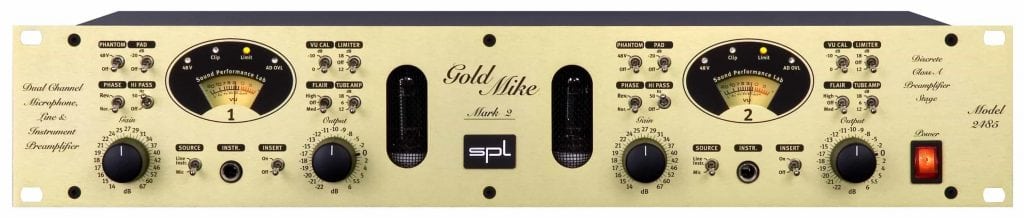
SPL GoldMike MK2 Dual-Channel Preamplifier w/ A to D Converter
GoldMike Mk2
Dual-Channel Microphone and Instrument Preamplifier
The GoldMike Mk2 combines Class-A transistor with a tube preamplifier.
The transistor stage is composed of single transistors in a Class A design and works in series with a tube preamplification stage that provides 6dB to 18dB of tube gain for subtle to more obvious saturation effects.
Like its successful predecessor, the GoldMike Mark2 AD retains a hybrid solid state and tube construction to combine the best of both worlds.
The Analog/Digital Converter Module 1090 offers an S/P-DIF output with both coaxial and optical connectors in parallel. The heart of the module is a 24-bit converter with a variable sample rate of up to 192 kHz. Highly accurate quartz oscillators ensure a clean, low-jitter master clock.
The internal sample rate can be switched between 44.1, 48, 88.2 and 96 kHz. Other sample rates (32, 176,4 and 192 kHz are set by external syncronization. The converter can be synced to other digital devices via a S/P-DIF input. The internal oscillators are automatically disabled when an external clock signal is present to prevent interference.
An extremely effective voltage stabilizing circuit ensures that the converter continuously receives sufficient and stable voltage – an important prerequisite for clean, transparent audio.
The compact design of the input stage guarantees the shortest possible signal path to the converter. Overdimensioned grounding surfaces on both sides of the circuit board effectively reduce interference and ensure optimal separation between analog and digital components.
The transistor stage is composed of single transistors in a class A design. The circuitry is fully discrete, and each transistor is completely optimized for its specific task. You will not find any IC’s in this preamplifier stage because they cannot be optimized for this specific application to the degree we aimed for.
This all new discrete class A transistor stage is a genuine innovation in the entire preamplifier market at this price level.- Frequency response ‹10Hz bis 90kHz (-3dB)
- THD+N (Input level -30dBu, 30dB Gain) 0,016%
- Noise (A-w., R=40Ohm, 30dB Gain) -91,2dBu
- Dynamic range (30dB Gain) 110dB
- E.I.N. 128dBu
- Max. output level (sym., XLR+Jack) +26,8dBu
- Slew rate solid state stage 200V/µs
The GoldMike MK2’s new features provide an amazing tonal flexibility and versatility, making it a perfect dual-channel frontend for any modern production environment.
- Discrete Class A solid stage
- Tube drive in three different intensity levels
- Flair presence enhancement in two switchable settings
- Switching inserts
- Pre-output limiter stage (extremely fast diode-based operation, perfect for A/D converter protection)
- VU metering with three different, switchable display ranges
- Front panel instrument input, separate rear-side microphone and line inputs
- Phantom power, phase reverse, pad and high-pass filter (50Hz)
- In/output transformers by Lundahl are optional
-

SPL HPm 1504 – 500 SERIES HEADPHONE AMP Factory Refurbished
Includes Full Warranty As New, from Manufacturer
HPm
Headphone Monitoring Amplifier
Headphone Monitoring Amp with Phonitor Matrix in 500 series dual rack module. With the Headphone Monitoring Amp HPm the SPL Phonitor Matrix is making headway into the world of 500 series rack modules.Each of the two headphone outputs is fed with a separate amplifier to allow independent operation of two headphones with high-quality amplification. Phase Inversion of left or right channel as well as a Stereo/Mono/Mute switch round off the feature set of the HPm.
-
SPL HPm 1504 – 500 SERIES Headphone Monitoring Amplifier
HPm
Headphone Monitoring Amplifier
Headphone Monitoring Amp with Phonitor Matrix in 500 series dual rack module. With the Headphone Monitoring Amp HPm the SPL Phonitor Matrix is making headway into the world of 500 series rack modules.Each of the two headphone outputs is fed with a separate amplifier to allow independent operation of two headphones with high-quality amplification. Phase Inversion of left or right channel as well as a Stereo/Mono/Mute switch round off the feature set of the HPm.
-

SPL IRON – 1520 Mastering Compressor Black
SPL Iron Mastering Compressor With tube Compressor Technology Dual-Tube Circuit
Mastering Compressor
The IRON mastering compressor is not a copy of a classic unit, but rather an original concept in itself. Our goal was to conceive a compressor that provided a pleasant, melodic-sounding, transparent compression, inspired on the vintage compressors of the radio era. And we wanted it to be versatile enough to adapt perfectly to the needs of modern mastering studios.
Thus, the IRON combines not only the sonic virtues of legendary vintage tube compressors with the advantages of the High Dynamic 120 V operating voltage in a single unit. It also sets a new benchmark in terms of tube compressor technology, with the innovative implementation of a parallel dual-tube circuit.
- Variable bias tube compressor
- Parallel dual tube circuit
- Tube selection and pairing with Weigl Roe Test
- Specially conceived Mu-Metal iron transformers
- Feed-forward resistive vactrol-opto-isolator
- Six different Rectifier settings available
- Sidechain that allows you to choose between Off, four sidechain-filter presets or an external sidechain signal.
- All functions can be adjusted via switches or, in the case of the Threshold, with a detented potentiometer
- In Link mode, the Threshold, Tube Bias, Attack, Release, and Rectifier parameters, as well as the Sidechain EQs, are controlled with the right side (channel 2) of the unit.
- Additional passive 120V equalizer with two presets
- High Dynamic 120V operating voltage
- Auto Bypass mode
- Made in Germany
Mastering Compressor
The IRON Mastering compressor combines not only the sonic virtues of legendary vintage tube compressors with the advantages of the High Dynamic 120V operating voltage in a single unit. It is also perfect for the needs of modern mastering studios and sets a new benchmark in terms of tube compressor technology, with the innovative implementation of a parallel dual-tube circuit.
Thanks to the especially conceived Mu-Metal iron transformers, the signal of each channel is split across two different twin-triode tubes. The combination of the different response curves of both tubes results in a transparent and musically pleasant compression. Additionally, peak signals of the control voltage are limited by a feed-forward resistive vactrol-opto-isolator. Thus, the output signal remains lively even with a high gain reduction. The compression is only noticeable with extreme settings.The Tube Bias has three different settings. Together with the Input Gain of up to +/- 12dB and the Threshold control, it allows the compression behavior of the tubes to be perfectly adapted to any material.
The Attack and Release parameters have six different settings ranging from Slow to Fast. The times are not constant, they vary according to the Rectifier circuit selected: There are six different Rectifier settings available with different diodes (germanium, silicon, LED, mixed).
The Sidechain EQ is yet another option to adjust the Iron to the signal being processed in an optimal way. It allows you to choose between an external EQ or one of the four internal EQ presets. The EQ presets have a complex frequency response and have been conceived with different program material in mind. Only the control signal is affected, not the actual audio signal. In the Off position, the Sidechain EQ is inactive.
After the compression stage, the signal can be boosted or attenuated up to +/- 12dB with the Output Gain, which makes the Iron easy to integrate into any signal chain.
All functions can be adjusted via switches or, in the case of the Threshold, with a detented potentiometer, making it easy to replicate exact settings.In stereo Link mode, the Threshold, Tube Bias, Attack, Release, and Rectifier parameters, as well as the Sidechain EQs, are controlled with the right side (channel 2) of the unit. In contrast to the Dual-Mono mode, in stereo Link mode the compressor works with a sum signal. Thus, the stereo image is wider when working with the Dual-Mono mode on stereo material.
The compressor has an additional passive 120V equalizer to give the output signal the finishing touches. You have two different EQ presets to choose from: AirBass and Tape Roll-Off. The AirBass mode gently boosts high and low frequencies approx. 2dB. For its part, the Tape Roll-Off mode is based on the frequency response of a tape machine and uses a high and a low-cut filter.
Both the left and right channels have separate illuminated activating switches. Further, in Auto Bypass mode you can use the Interval control to set a time frame during which the compressor automatically toggles back and forth between the processed and unprocessed signals. This makes AB comparisons between the original and compressed signals a breeze, besides making it easier to assess the settings in context.
The ergonomic design and clear arrangement of the control elements make working with the compressor more intuitive, while its shallow housing makes the Iron perfectly adaptable to tabletop rack stands.Mastering is not the only domain where the IRON sets new standards. It can also be used to process individual instruments, like vocals, bass, guitar, strings, etc. The IRON is also an excellent option for subgroups.
Operating Principles of a Compressor
The basic operating principles of a compressor/limiter can be easily explained. The level of an audio signal is reduced according to the specified attack time and ratio whenever it exceeds a given threshold. This reduction ceases when the release time elapses, while the compressed signal is amplified with the make-up gain.åÊ
Compressors basically differ from each other in the technology used. This technology – tubes, opto, FET, or VCA – is what gives a compressor its particular character. Some units sound soft and silky, some sound pounding, while some others make sound fatter, and there are those that make sound clearer, harder or more percussive. The trick resides in how the unit is technically designed, in the signature of the maker. Different compressors with the exact same settings might work and sound completely different. They provide different sounds for different applications and music styles.
Nowadays, the compressor has become a key element when it comes to provide dynamicsand punch to any production. The number of compressors available is huge and itÛ÷seasy to succumb to the promises made by software emulations and analog recreations ofvintage gear as the perfect solution. Unfortunately, many of these emulations and recreationsdiffer quite a bit form their original counterparts. You must simply accept that the components used today, like the transformers, tubes and all other passive elements, are different to the ones originally used and that they canÛ÷t be digitally emulated. No software (DSP-emulated compressors) or hardware replica will ever be able to sound like the original. An authentic sound can only be achieved with the original unit.
Innovating Compression
The IRON mastering compressor was conceived as a variable-bias limiter/compressor right from the start. However, the implementation of new technologies results in many improvements. Its basic operating principle as a variable-bias tube compressor was loosely inspired by the sonic and technical operation of Fairchild, Collins and Gates compressors, which used remote cut-off of tube biasing to achieve a well-balanced, well-compensated and musical compression.åÊ
However, the IRON compressor features a second sharp cut-off tube, a medium-variable bias triode, in its circuit design. This tube is connected in parallel to the remote cut-off tube and it has a considerably steeper characteristic curve. The tube used to process the signal depends on the amplitude of the latter. This results in a more well-balanced sound and more controllable settings of the parameters. The pair of parallel connected tubes has been specially matched for the IRON. In order to guarantee that tube selection and pairing is perfect, we use the Weigl Roe Test for PC. The optimal selection of the tubes guarantees that all IRONs have the same sonic characteristics.åÊMoreover, we use Lundahl custom-made balanced high-level dual-coil mu-metal iron transformers in the signal flow of the variable-bias tubes, which add to the overall sound.åÊ
The second new technology implemented is the independent feed-forward resistive opto-isolator in the control path of the variable-bias tube circuit. Its function is to limit signal peaks and, thus, get a smaller THD (Total Harmonic Distortion) within the variable-bias tube section. The result is a silkier, more homogeneous sound in the higher frequencies of the music signal. This circuit has its own rectifier in the signal path. The optical control element does not work in the sense of an audio limiter, like in a conventional opto-compressor. It is built-in in the control path of the parallel connected variable-bias tube, not in the audio path itself. Time control parameters, like attack and release time, are adaptedand fixed to the variable-bias tube circuit.åÊThe IRON compressor works as a feedback compressor when set to the variable-bias tube circuit and as a feed-forward compressor when set to the opto-control circuit.Thirdly, the complex rectifier circuit is also worth mentioning, since it is the basis for tube control. You can use the six-position switch to choose either of the six different control characteristic curves of the diodes within the rectifier. Given the specific characteristic curve of its elements, the combination of germanium, silicon and LED diodes produces different behaviors and characteristics for the Attack and Release times.åÊ
Hence, compared to most compressors, the application scope of the IRON is clearly enlarged, resulting in new possibilities regarding the processing of music material. The fourth exceptional feature is the comprehensive logical relay circuit that perfectly links both channels together, making the right channel the Master regarding Release, Attack, Threshold, Rectifier, Tube-Bias and Side-Chain EQ settings.
120 Volt Technology
SPLÛ÷s goal was to push analog signal processing to the limits. ThatÛ÷s why we combined the best possible components with a high-grade optimized circuit design. We have been using the in-house developed 120 volt technology – the highest-ever operating voltage used for audio applications – in all our products of the mastering series for years.åÊ
Some of the most highly respected mastering studios today revolve around SPL consoles and signal processors from our mastering series (Bob Ludwigs Gateway Mastering & DVD in the USA, Simon HeyworthÛ÷s Super Audio Mastering in the UK, Galaxy Studios in Belgium, and the legendary Wisseloord in the Netherlands, for instance).åÊ
The 120 volt technology is based on op-amps developed internally by SPLÛ÷s founders together with chief developer Wolfgang Neumann. The IRON features the most advanced generation of these op-amps. They boast better tech specs thanks to the thermal behavior optimization they underwent under the hands of Bastian Neu. Ultimately, the supply voltage is key for the overall dynamic response of a processor. Voltage is to an electrical circuit what cylinder capacity is to an internal combustion engine. You canÛ÷t replace cylinder capacity with anything else, except more cylinder capacity.
åÊ
Frequency Range (40 kHz = -3 dB): 10 Hz – 40 kHz
CMRR (bei 0 dBu):1 kHz: Û¼ 80 dB / 10 kHz: Û¼ 65 dB
THD & N (0 dBu): Û¼ 82 dB
Noise (A-weighted): -98 dBu
åÊ
Total Harmonic Distortion
-10 dBu:
- 0,3% at 100 Hz
- 0,06% at 1 kHz
- 0,02% at 15 kHz
0 dBu: 0,01% at 1kHz
+10 dBu: 0,002% at 1kHz
åÊ
Inputs
- Input Impedance: 20 kOhm
- Max. Input Level: +32,5 dBu
åÊ
Outputs
- Max. Output Level: +32,5 dBu
- Output Impedance: Û_ 50 Ohm
åÊ
Power Consumption:
- 0,24 Amp, 230V/50Hz, 44 Watt, 55 VA
- 0,46 Amp, 115V/60Hz, 42 Watt, 52 VA
åÊ
Fuses:
- 230 V/50 Hz: 1 Amp
- 115 V/60 Hz: 2 Amp
åÊ
Dimensions & Weight
- W x H x D: 482 x 177 x 311,5mm; 19″ x 7″ x 12.25″
Standard EIA 19″ Housing/4U - Weight: 11kg / 24,25lb
-
SPL IRON 1520 Mastering Compressor Black B-Stock
Includes Full Warranty As New, from Manufacturer
SPL Iron Mastering Compressor With tube Compressor Technology Dual-Tube Circuit
Mastering Compressor
The IRON mastering compressor is not a copy of a classic unit, but rather an original concept in itself. Our goal was to conceive a compressor that provided a pleasant, melodic-sounding, transparent compression, inspired on the vintage compressors of the radio era. And we wanted it to be versatile enough to adapt perfectly to the needs of modern mastering studios.
Thus, the IRON combines not only the sonic virtues of legendary vintage tube compressors with the advantages of the High Dynamic 120 V operating voltage in a single unit. It also sets a new benchmark in terms of tube compressor technology, with the innovative implementation of a parallel dual-tube circuit.
- Variable bias tube compressor
- Parallel dual tube circuit
- Tube selection and pairing with Weigl Roe Test
- Specially conceived Mu-Metal iron transformers
- Feed-forward resistive vactrol-opto-isolator
- Six different Rectifier settings available
- Sidechain that allows you to choose between Off, four sidechain-filter presets or an external sidechain signal.
- All functions can be adjusted via switches or, in the case of the Threshold, with a detented potentiometer
- In Link mode, the Threshold, Tube Bias, Attack, Release, and Rectifier parameters, as well as the Sidechain EQs, are controlled with the right side (channel 2) of the unit.
- Additional passive 120V equalizer with two presets
- High Dynamic 120V operating voltage
- Auto Bypass mode
- Made in Germany
Mastering Compressor
The IRON Mastering compressor combines not only the sonic virtues of legendary vintage tube compressors with the advantages of the High Dynamic 120V operating voltage in a single unit. It is also perfect for the needs of modern mastering studios and sets a new benchmark in terms of tube compressor technology, with the innovative implementation of a parallel dual-tube circuit.
Thanks to the especially conceived Mu-Metal iron transformers, the signal of each channel is split across two different twin-triode tubes. The combination of the different response curves of both tubes results in a transparent and musically pleasant compression. Additionally, peak signals of the control voltage are limited by a feed-forward resistive vactrol-opto-isolator. Thus, the output signal remains lively even with a high gain reduction. The compression is only noticeable with extreme settings.The Tube Bias has three different settings. Together with the Input Gain of up to +/- 12dB and the Threshold control, it allows the compression behavior of the tubes to be perfectly adapted to any material.
The Attack and Release parameters have six different settings ranging from Slow to Fast. The times are not constant, they vary according to the Rectifier circuit selected: There are six different Rectifier settings available with different diodes (germanium, silicon, LED, mixed).
The Sidechain EQ is yet another option to adjust the Iron to the signal being processed in an optimal way. It allows you to choose between an external EQ or one of the four internal EQ presets. The EQ presets have a complex frequency response and have been conceived with different program material in mind. Only the control signal is affected, not the actual audio signal. In the Off position, the Sidechain EQ is inactive.
After the compression stage, the signal can be boosted or attenuated up to +/- 12dB with the Output Gain, which makes the Iron easy to integrate into any signal chain.
All functions can be adjusted via switches or, in the case of the Threshold, with a detented potentiometer, making it easy to replicate exact settings.In stereo Link mode, the Threshold, Tube Bias, Attack, Release, and Rectifier parameters, as well as the Sidechain EQs, are controlled with the right side (channel 2) of the unit. In contrast to the Dual-Mono mode, in stereo Link mode the compressor works with a sum signal. Thus, the stereo image is wider when working with the Dual-Mono mode on stereo material.
The compressor has an additional passive 120V equalizer to give the output signal the finishing touches. You have two different EQ presets to choose from: AirBass and Tape Roll-Off. The AirBass mode gently boosts high and low frequencies approx. 2dB. For its part, the Tape Roll-Off mode is based on the frequency response of a tape machine and uses a high and a low-cut filter.
Both the left and right channels have separate illuminated activating switches. Further, in Auto Bypass mode you can use the Interval control to set a time frame during which the compressor automatically toggles back and forth between the processed and unprocessed signals. This makes AB comparisons between the original and compressed signals a breeze, besides making it easier to assess the settings in context.
The ergonomic design and clear arrangement of the control elements make working with the compressor more intuitive, while its shallow housing makes the Iron perfectly adaptable to tabletop rack stands.Mastering is not the only domain where the IRON sets new standards. It can also be used to process individual instruments, like vocals, bass, guitar, strings, etc. The IRON is also an excellent option for subgroups.
Operating Principles of a Compressor
The basic operating principles of a compressor/limiter can be easily explained. The level of an audio signal is reduced according to the specified attack time and ratio whenever it exceeds a given threshold. This reduction ceases when the release time elapses, while the compressed signal is amplified with the make-up gain.åÊ
Compressors basically differ from each other in the technology used. This technology – tubes, opto, FET, or VCA – is what gives a compressor its particular character. Some units sound soft and silky, some sound pounding, while some others make sound fatter, and there are those that make sound clearer, harder or more percussive. The trick resides in how the unit is technically designed, in the signature of the maker. Different compressors with the exact same settings might work and sound completely different. They provide different sounds for different applications and music styles.
Nowadays, the compressor has become a key element when it comes to provide dynamicsand punch to any production. The number of compressors available is huge and itÛ÷seasy to succumb to the promises made by software emulations and analog recreations ofvintage gear as the perfect solution. Unfortunately, many of these emulations and recreationsdiffer quite a bit form their original counterparts. You must simply accept that the components used today, like the transformers, tubes and all other passive elements, are different to the ones originally used and that they canÛ÷t be digitally emulated. No software (DSP-emulated compressors) or hardware replica will ever be able to sound like the original. An authentic sound can only be achieved with the original unit.
Innovating Compression
The IRON mastering compressor was conceived as a variable-bias limiter/compressor right from the start. However, the implementation of new technologies results in many improvements. Its basic operating principle as a variable-bias tube compressor was loosely inspired by the sonic and technical operation of Fairchild, Collins and Gates compressors, which used remote cut-off of tube biasing to achieve a well-balanced, well-compensated and musical compression.åÊ
However, the IRON compressor features a second sharp cut-off tube, a medium-variable bias triode, in its circuit design. This tube is connected in parallel to the remote cut-off tube and it has a considerably steeper characteristic curve. The tube used to process the signal depends on the amplitude of the latter. This results in a more well-balanced sound and more controllable settings of the parameters. The pair of parallel connected tubes has been specially matched for the IRON. In order to guarantee that tube selection and pairing is perfect, we use the Weigl Roe Test for PC. The optimal selection of the tubes guarantees that all IRONs have the same sonic characteristics.åÊMoreover, we use Lundahl custom-made balanced high-level dual-coil mu-metal iron transformers in the signal flow of the variable-bias tubes, which add to the overall sound.åÊ
The second new technology implemented is the independent feed-forward resistive opto-isolator in the control path of the variable-bias tube circuit. Its function is to limit signal peaks and, thus, get a smaller THD (Total Harmonic Distortion) within the variable-bias tube section. The result is a silkier, more homogeneous sound in the higher frequencies of the music signal. This circuit has its own rectifier in the signal path. The optical control element does not work in the sense of an audio limiter, like in a conventional opto-compressor. It is built-in in the control path of the parallel connected variable-bias tube, not in the audio path itself. Time control parameters, like attack and release time, are adaptedand fixed to the variable-bias tube circuit.åÊThe IRON compressor works as a feedback compressor when set to the variable-bias tube circuit and as a feed-forward compressor when set to the opto-control circuit.Thirdly, the complex rectifier circuit is also worth mentioning, since it is the basis for tube control. You can use the six-position switch to choose either of the six different control characteristic curves of the diodes within the rectifier. Given the specific characteristic curve of its elements, the combination of germanium, silicon and LED diodes produces different behaviors and characteristics for the Attack and Release times.åÊ
Hence, compared to most compressors, the application scope of the IRON is clearly enlarged, resulting in new possibilities regarding the processing of music material. The fourth exceptional feature is the comprehensive logical relay circuit that perfectly links both channels together, making the right channel the Master regarding Release, Attack, Threshold, Rectifier, Tube-Bias and Side-Chain EQ settings.
120 Volt Technology
SPLÛ÷s goal was to push analog signal processing to the limits. ThatÛ÷s why we combined the best possible components with a high-grade optimized circuit design. We have been using the in-house developed 120 volt technology – the highest-ever operating voltage used for audio applications – in all our products of the mastering series for years.åÊ
Some of the most highly respected mastering studios today revolve around SPL consoles and signal processors from our mastering series (Bob Ludwigs Gateway Mastering & DVD in the USA, Simon HeyworthÛ÷s Super Audio Mastering in the UK, Galaxy Studios in Belgium, and the legendary Wisseloord in the Netherlands, for instance).åÊ
The 120 volt technology is based on op-amps developed internally by SPLÛ÷s founders together with chief developer Wolfgang Neumann. The IRON features the most advanced generation of these op-amps. They boast better tech specs thanks to the thermal behavior optimization they underwent under the hands of Bastian Neu. Ultimately, the supply voltage is key for the overall dynamic response of a processor. Voltage is to an electrical circuit what cylinder capacity is to an internal combustion engine. You canÛ÷t replace cylinder capacity with anything else, except more cylinder capacity.
åÊ
Frequency Range (40 kHz = -3 dB): 10 Hz – 40 kHz
CMRR (bei 0 dBu):1 kHz: Û¼ 80 dB / 10 kHz: Û¼ 65 dB
THD & N (0 dBu): Û¼ 82 dB
Noise (A-weighted): -98 dBu
åÊ
Total Harmonic Distortion
-10 dBu:
- 0,3% at 100 Hz
- 0,06% at 1 kHz
- 0,02% at 15 kHz
0 dBu: 0,01% at 1kHz
+10 dBu: 0,002% at 1kHz
åÊ
Inputs
- Input Impedance: 20 kOhm
- Max. Input Level: +32,5 dBu
åÊ
Outputs
- Max. Output Level: +32,5 dBu
- Output Impedance: Û_ 50 Ohm
åÊ
Power Consumption:
- 0,24 Amp, 230V/50Hz, 44 Watt, 55 VA
- 0,46 Amp, 115V/60Hz, 42 Watt, 52 VA
åÊ
Fuses:
- 230 V/50 Hz: 1 Amp
- 115 V/60 Hz: 2 Amp
åÊ
Dimensions & Weight
- W x H x D: 482 x 177 x 311,5mm; 19″ x 7″ x 12.25″
Standard EIA 19″ Housing/4U - Weight: 11kg / 24,25lb
-
SPL IRON 1520 Mastering Compressor Black Factory Refurbished
Includes Full Warranty As New, from Manufacturer
SPL Iron Mastering Compressor With tube Compressor Technology Dual-Tube Circuit
Mastering Compressor
The IRON mastering compressor is not a copy of a classic unit, but rather an original concept in itself. Our goal was to conceive a compressor that provided a pleasant, melodic-sounding, transparent compression, inspired on the vintage compressors of the radio era. And we wanted it to be versatile enough to adapt perfectly to the needs of modern mastering studios.
Thus, the IRON combines not only the sonic virtues of legendary vintage tube compressors with the advantages of the High Dynamic 120 V operating voltage in a single unit. It also sets a new benchmark in terms of tube compressor technology, with the innovative implementation of a parallel dual-tube circuit.
- Variable bias tube compressor
- Parallel dual tube circuit
- Tube selection and pairing with Weigl Roe Test
- Specially conceived Mu-Metal iron transformers
- Feed-forward resistive vactrol-opto-isolator
- Six different Rectifier settings available
- Sidechain that allows you to choose between Off, four sidechain-filter presets or an external sidechain signal.
- All functions can be adjusted via switches or, in the case of the Threshold, with a detented potentiometer
- In Link mode, the Threshold, Tube Bias, Attack, Release, and Rectifier parameters, as well as the Sidechain EQs, are controlled with the right side (channel 2) of the unit.
- Additional passive 120V equalizer with two presets
- High Dynamic 120V operating voltage
- Auto Bypass mode
- Made in Germany
Mastering Compressor
The IRON Mastering compressor combines not only the sonic virtues of legendary vintage tube compressors with the advantages of the High Dynamic 120V operating voltage in a single unit. It is also perfect for the needs of modern mastering studios and sets a new benchmark in terms of tube compressor technology, with the innovative implementation of a parallel dual-tube circuit.
Thanks to the especially conceived Mu-Metal iron transformers, the signal of each channel is split across two different twin-triode tubes. The combination of the different response curves of both tubes results in a transparent and musically pleasant compression. Additionally, peak signals of the control voltage are limited by a feed-forward resistive vactrol-opto-isolator. Thus, the output signal remains lively even with a high gain reduction. The compression is only noticeable with extreme settings.The Tube Bias has three different settings. Together with the Input Gain of up to +/- 12dB and the Threshold control, it allows the compression behavior of the tubes to be perfectly adapted to any material.
The Attack and Release parameters have six different settings ranging from Slow to Fast. The times are not constant, they vary according to the Rectifier circuit selected: There are six different Rectifier settings available with different diodes (germanium, silicon, LED, mixed).
The Sidechain EQ is yet another option to adjust the Iron to the signal being processed in an optimal way. It allows you to choose between an external EQ or one of the four internal EQ presets. The EQ presets have a complex frequency response and have been conceived with different program material in mind. Only the control signal is affected, not the actual audio signal. In the Off position, the Sidechain EQ is inactive.
After the compression stage, the signal can be boosted or attenuated up to +/- 12dB with the Output Gain, which makes the Iron easy to integrate into any signal chain.
All functions can be adjusted via switches or, in the case of the Threshold, with a detented potentiometer, making it easy to replicate exact settings.In stereo Link mode, the Threshold, Tube Bias, Attack, Release, and Rectifier parameters, as well as the Sidechain EQs, are controlled with the right side (channel 2) of the unit. In contrast to the Dual-Mono mode, in stereo Link mode the compressor works with a sum signal. Thus, the stereo image is wider when working with the Dual-Mono mode on stereo material.
The compressor has an additional passive 120V equalizer to give the output signal the finishing touches. You have two different EQ presets to choose from: AirBass and Tape Roll-Off. The AirBass mode gently boosts high and low frequencies approx. 2dB. For its part, the Tape Roll-Off mode is based on the frequency response of a tape machine and uses a high and a low-cut filter.
Both the left and right channels have separate illuminated activating switches. Further, in Auto Bypass mode you can use the Interval control to set a time frame during which the compressor automatically toggles back and forth between the processed and unprocessed signals. This makes AB comparisons between the original and compressed signals a breeze, besides making it easier to assess the settings in context.
The ergonomic design and clear arrangement of the control elements make working with the compressor more intuitive, while its shallow housing makes the Iron perfectly adaptable to tabletop rack stands.Mastering is not the only domain where the IRON sets new standards. It can also be used to process individual instruments, like vocals, bass, guitar, strings, etc. The IRON is also an excellent option for subgroups.
Operating Principles of a Compressor
The basic operating principles of a compressor/limiter can be easily explained. The level of an audio signal is reduced according to the specified attack time and ratio whenever it exceeds a given threshold. This reduction ceases when the release time elapses, while the compressed signal is amplified with the make-up gain.åÊ
Compressors basically differ from each other in the technology used. This technology – tubes, opto, FET, or VCA – is what gives a compressor its particular character. Some units sound soft and silky, some sound pounding, while some others make sound fatter, and there are those that make sound clearer, harder or more percussive. The trick resides in how the unit is technically designed, in the signature of the maker. Different compressors with the exact same settings might work and sound completely different. They provide different sounds for different applications and music styles.
Nowadays, the compressor has become a key element when it comes to provide dynamicsand punch to any production. The number of compressors available is huge and itÛ÷seasy to succumb to the promises made by software emulations and analog recreations ofvintage gear as the perfect solution. Unfortunately, many of these emulations and recreationsdiffer quite a bit form their original counterparts. You must simply accept that the components used today, like the transformers, tubes and all other passive elements, are different to the ones originally used and that they canÛ÷t be digitally emulated. No software (DSP-emulated compressors) or hardware replica will ever be able to sound like the original. An authentic sound can only be achieved with the original unit.
Innovating Compression
The IRON mastering compressor was conceived as a variable-bias limiter/compressor right from the start. However, the implementation of new technologies results in many improvements. Its basic operating principle as a variable-bias tube compressor was loosely inspired by the sonic and technical operation of Fairchild, Collins and Gates compressors, which used remote cut-off of tube biasing to achieve a well-balanced, well-compensated and musical compression.åÊ
However, the IRON compressor features a second sharp cut-off tube, a medium-variable bias triode, in its circuit design. This tube is connected in parallel to the remote cut-off tube and it has a considerably steeper characteristic curve. The tube used to process the signal depends on the amplitude of the latter. This results in a more well-balanced sound and more controllable settings of the parameters. The pair of parallel connected tubes has been specially matched for the IRON. In order to guarantee that tube selection and pairing is perfect, we use the Weigl Roe Test for PC. The optimal selection of the tubes guarantees that all IRONs have the same sonic characteristics.åÊMoreover, we use Lundahl custom-made balanced high-level dual-coil mu-metal iron transformers in the signal flow of the variable-bias tubes, which add to the overall sound.åÊ
The second new technology implemented is the independent feed-forward resistive opto-isolator in the control path of the variable-bias tube circuit. Its function is to limit signal peaks and, thus, get a smaller THD (Total Harmonic Distortion) within the variable-bias tube section. The result is a silkier, more homogeneous sound in the higher frequencies of the music signal. This circuit has its own rectifier in the signal path. The optical control element does not work in the sense of an audio limiter, like in a conventional opto-compressor. It is built-in in the control path of the parallel connected variable-bias tube, not in the audio path itself. Time control parameters, like attack and release time, are adaptedand fixed to the variable-bias tube circuit.åÊThe IRON compressor works as a feedback compressor when set to the variable-bias tube circuit and as a feed-forward compressor when set to the opto-control circuit.Thirdly, the complex rectifier circuit is also worth mentioning, since it is the basis for tube control. You can use the six-position switch to choose either of the six different control characteristic curves of the diodes within the rectifier. Given the specific characteristic curve of its elements, the combination of germanium, silicon and LED diodes produces different behaviors and characteristics for the Attack and Release times.åÊ
Hence, compared to most compressors, the application scope of the IRON is clearly enlarged, resulting in new possibilities regarding the processing of music material. The fourth exceptional feature is the comprehensive logical relay circuit that perfectly links both channels together, making the right channel the Master regarding Release, Attack, Threshold, Rectifier, Tube-Bias and Side-Chain EQ settings.
120 Volt Technology
SPLÛ÷s goal was to push analog signal processing to the limits. ThatÛ÷s why we combined the best possible components with a high-grade optimized circuit design. We have been using the in-house developed 120 volt technology – the highest-ever operating voltage used for audio applications – in all our products of the mastering series for years.åÊ
Some of the most highly respected mastering studios today revolve around SPL consoles and signal processors from our mastering series (Bob Ludwigs Gateway Mastering & DVD in the USA, Simon HeyworthÛ÷s Super Audio Mastering in the UK, Galaxy Studios in Belgium, and the legendary Wisseloord in the Netherlands, for instance).åÊ
The 120 volt technology is based on op-amps developed internally by SPLÛ÷s founders together with chief developer Wolfgang Neumann. The IRON features the most advanced generation of these op-amps. They boast better tech specs thanks to the thermal behavior optimization they underwent under the hands of Bastian Neu. Ultimately, the supply voltage is key for the overall dynamic response of a processor. Voltage is to an electrical circuit what cylinder capacity is to an internal combustion engine. You canÛ÷t replace cylinder capacity with anything else, except more cylinder capacity.
åÊ
Frequency Range (40 kHz = -3 dB): 10 Hz – 40 kHz
CMRR (bei 0 dBu):1 kHz: Û¼ 80 dB / 10 kHz: Û¼ 65 dB
THD & N (0 dBu): Û¼ 82 dB
Noise (A-weighted): -98 dBu
åÊ
Total Harmonic Distortion
-10 dBu:
- 0,3% at 100 Hz
- 0,06% at 1 kHz
- 0,02% at 15 kHz
0 dBu: 0,01% at 1kHz
+10 dBu: 0,002% at 1kHz
åÊ
Inputs
- Input Impedance: 20 kOhm
- Max. Input Level: +32,5 dBu
åÊ
Outputs
- Max. Output Level: +32,5 dBu
- Output Impedance: Û_ 50 Ohm
åÊ
Power Consumption:
- 0,24 Amp, 230V/50Hz, 44 Watt, 55 VA
- 0,46 Amp, 115V/60Hz, 42 Watt, 52 VA
åÊ
Fuses:
- 230 V/50 Hz: 1 Amp
- 115 V/60 Hz: 2 Amp
åÊ
Dimensions & Weight
- W x H x D: 482 x 177 x 311,5mm; 19″ x 7″ x 12.25″
Standard EIA 19″ Housing/4U - Weight: 11kg / 24,25lb
-

SPL IRON RED – 1524 Mastering Compressor
IRON
Mastering Compressor
The IRON mastering compressor is not a copy of a classic unit, but rather an original concept in itself. Our goal was to conceive a compressor that provided a pleasant, melodic-sounding, transparent compression, inspired on the vintage compressors of the radio era. And we wanted it to be versatile enough to adapt perfectly to the needs of modern mastering studios.
Thus, the IRON combines not only the sonic virtues of legendary vintage tube compressors with the advantages of the High Dynamic 120 V operating voltage in a single unit. It also sets a new benchmark in terms of tube compressor technology, with the innovative implementation of a parallel dual-tube circuit.
- Variable bias tube compressor
- Parallel dual tube circuit
- Tube selection and pairing with Weigl Roe Test
- Specially conceived Mu-Metal iron transformers
- Feed-forward resistive vactrol-opto-isolator
- Six different Rectifier settings available
- Sidechain that allows you to choose between Off, four sidechain-filter presets or an external sidechain signal.
- All functions can be adjusted via switches or, in the case of the Threshold, with a detented potentiometer
- In Link mode, the Threshold, Tube Bias, Attack, Release, and Rectifier parameters, as well as the Sidechain EQs, are controlled with the right side (channel 2) of the unit.
- Additional passive 120V equalizer with two presets
- High Dynamic 120V operating voltage
- Auto Bypass mode
- Made in Germany
Mastering Compressor
The IRON Mastering compressor combines not only the sonic virtues of legendary vintage tube compressors with the advantages of the High Dynamic 120V operating voltage in a single unit. It is also perfect for the needs of modern mastering studios and sets a new benchmark in terms of tube compressor technology, with the innovative implementation of a parallel dual-tube circuit.
Thanks to the especially conceived Mu-Metal iron transformers, the signal of each channel is split across two different twin-triode tubes. The combination of the different response curves of both tubes results in a transparent and musically pleasant compression. Additionally, peak signals of the control voltage are limited by a feed-forward resistive vactrol-opto-isolator. Thus, the output signal remains lively even with a high gain reduction. The compression is only noticeable with extreme settings.The Tube Bias has three different settings. Together with the Input Gain of up to +/- 12dB and the Threshold control, it allows the compression behavior of the tubes to be perfectly adapted to any material.
The Attack and Release parameters have six different settings ranging from Slow to Fast. The times are not constant, they vary according to the Rectifier circuit selected: There are six different Rectifier settings available with different diodes (germanium, silicon, LED, mixed).
The Sidechain EQ is yet another option to adjust the Iron to the signal being processed in an optimal way. It allows you to choose between an external EQ or one of the four internal EQ presets. The EQ presets have a complex frequency response and have been conceived with different program material in mind. Only the control signal is affected, not the actual audio signal. In the Off position, the Sidechain EQ is inactive.
After the compression stage, the signal can be boosted or attenuated up to +/- 12dB with the Output Gain, which makes the Iron easy to integrate into any signal chain.
All functions can be adjusted via switches or, in the case of the Threshold, with a detented potentiometer, making it easy to replicate exact settings.In stereo Link mode, the Threshold, Tube Bias, Attack, Release, and Rectifier parameters, as well as the Sidechain EQs, are controlled with the right side (channel 2) of the unit. In contrast to the Dual-Mono mode, in stereo Link mode the compressor works with a sum signal. Thus, the stereo image is wider when working with the Dual-Mono mode on stereo material.
The compressor has an additional passive 120V equalizer to give the output signal the finishing touches. You have two different EQ presets to choose from: AirBass and Tape Roll-Off. The AirBass mode gently boosts high and low frequencies approx. 2dB. For its part, the Tape Roll-Off mode is based on the frequency response of a tape machine and uses a high and a low-cut filter.
Both the left and right channels have separate illuminated activating switches. Further, in Auto Bypass mode you can use the Interval control to set a time frame during which the compressor automatically toggles back and forth between the processed and unprocessed signals. This makes AB comparisons between the original and compressed signals a breeze, besides making it easier to assess the settings in context.
The ergonomic design and clear arrangement of the control elements make working with the compressor more intuitive, while its shallow housing makes the Iron perfectly adaptable to tabletop rack stands.Mastering is not the only domain where the IRON sets new standards. It can also be used to process individual instruments, like vocals, bass, guitar, strings, etc. The IRON is also an excellent option for subgroups.
Operating Principles of a Compressor
The basic operating principles of a compressor/limiter can be easily explained. The level of an audio signal is reduced according to the specified attack time and ratio whenever it exceeds a given threshold. This reduction ceases when the release time elapses, while the compressed signal is amplified with the make-up gain.åÊ
Compressors basically differ from each other in the technology used. This technology – tubes, opto, FET, or VCA – is what gives a compressor its particular character. Some units sound soft and silky, some sound pounding, while some others make sound fatter, and there are those that make sound clearer, harder or more percussive. The trick resides in how the unit is technically designed, in the signature of the maker. Different compressors with the exact same settings might work and sound completely different. They provide different sounds for different applications and music styles.
Nowadays, the compressor has become a key element when it comes to provide dynamicsand punch to any production. The number of compressors available is huge and itÛ÷seasy to succumb to the promises made by software emulations and analog recreations ofvintage gear as the perfect solution. Unfortunately, many of these emulations and recreationsdiffer quite a bit form their original counterparts. You must simply accept that the components used today, like the transformers, tubes and all other passive elements, are different to the ones originally used and that they canÛ÷t be digitally emulated. No software (DSP-emulated compressors) or hardware replica will ever be able to sound like the original. An authentic sound can only be achieved with the original unit.
Innovating Compression
The IRON mastering compressor was conceived as a variable-bias limiter/compressor right from the start. However, the implementation of new technologies results in many improvements. Its basic operating principle as a variable-bias tube compressor was loosely inspired by the sonic and technical operation of Fairchild, Collins and Gates compressors, which used remote cut-off of tube biasing to achieve a well-balanced, well-compensated and musical compression.åÊ
However, the IRON compressor features a second sharp cut-off tube, a medium-variable bias triode, in its circuit design. This tube is connected in parallel to the remote cut-off tube and it has a considerably steeper characteristic curve. The tube used to process the signal depends on the amplitude of the latter. This results in a more well-balanced sound and more controllable settings of the parameters. The pair of parallel connected tubes has been specially matched for the IRON. In order to guarantee that tube selection and pairing is perfect, we use the Weigl Roe Test for PC. The optimal selection of the tubes guarantees that all IRONs have the same sonic characteristics.åÊMoreover, we use Lundahl custom-made balanced high-level dual-coil mu-metal iron transformers in the signal flow of the variable-bias tubes, which add to the overall sound.åÊ
The second new technology implemented is the independent feed-forward resistive opto-isolator in the control path of the variable-bias tube circuit. Its function is to limit signal peaks and, thus, get a smaller THD (Total Harmonic Distortion) within the variable-bias tube section. The result is a silkier, more homogeneous sound in the higher frequencies of the music signal. This circuit has its own rectifier in the signal path. The optical control element does not work in the sense of an audio limiter, like in a conventional opto-compressor. It is built-in in the control path of the parallel connected variable-bias tube, not in the audio path itself. Time control parameters, like attack and release time, are adaptedand fixed to the variable-bias tube circuit.åÊThe IRON compressor works as a feedback compressor when set to the variable-bias tube circuit and as a feed-forward compressor when set to the opto-control circuit.Thirdly, the complex rectifier circuit is also worth mentioning, since it is the basis for tube control. You can use the six-position switch to choose either of the six different control characteristic curves of the diodes within the rectifier. Given the specific characteristic curve of its elements, the combination of germanium, silicon and LED diodes produces different behaviors and characteristics for the Attack and Release times.åÊ
Hence, compared to most compressors, the application scope of the IRON is clearly enlarged, resulting in new possibilities regarding the processing of music material. The fourth exceptional feature is the comprehensive logical relay circuit that perfectly links both channels together, making the right channel the Master regarding Release, Attack, Threshold, Rectifier, Tube-Bias and Side-Chain EQ settings.
120 Volt Technology
SPLÛ÷s goal was to push analog signal processing to the limits. ThatÛ÷s why we combined the best possible components with a high-grade optimized circuit design. We have been using the in-house developed 120 volt technology – the highest-ever operating voltage used for audio applications – in all our products of the mastering series for years.åÊ
Some of the most highly respected mastering studios today revolve around SPL consoles and signal processors from our mastering series (Bob Ludwigs Gateway Mastering & DVD in the USA, Simon HeyworthÛ÷s Super Audio Mastering in the UK, Galaxy Studios in Belgium, and the legendary Wisseloord in the Netherlands, for instance).åÊ
The 120 volt technology is based on op-amps developed internally by SPLÛ÷s founders together with chief developer Wolfgang Neumann. The IRON features the most advanced generation of these op-amps. They boast better tech specs thanks to the thermal behavior optimization they underwent under the hands of Bastian Neu. Ultimately, the supply voltage is key for the overall dynamic response of a processor. Voltage is to an electrical circuit what cylinder capacity is to an internal combustion engine. You canÛ÷t replace cylinder capacity with anything else, except more cylinder capacity.
åÊ
Frequency Range (40 kHz = -3 dB): 10 Hz – 40 kHz
CMRR (bei 0 dBu):1 kHz: Û¼ 80 dB / 10 kHz: Û¼ 65 dB
THD & N (0 dBu): Û¼ 82 dB
Noise (A-weighted): -98 dBu
åÊ
Total Harmonic Distortion
-10 dBu:
- 0,3% at 100 Hz
- 0,06% at 1 kHz
- 0,02% at 15 kHz
0 dBu: 0,01% at 1kHz
+10 dBu: 0,002% at 1kHz
åÊ
Inputs
- Input Impedance: 20 kOhm
- Max. Input Level: +32,5 dBu
åÊ
Outputs
- Max. Output Level: +32,5 dBu
- Output Impedance: Û_ 50 Ohm
åÊ
Power Consumption:
- 0,24 Amp, 230V/50Hz, 44 Watt, 55 VA
- 0,46 Amp, 115V/60Hz, 42 Watt, 52 VA
åÊ
Fuses:
- 230 V/50 Hz: 1 Amp
- 115 V/60 Hz: 2 Amp
åÊ
Dimensions & Weight
- W x H x D: 482 x 177 x 311,5mm; 19″ x 7″ x 12.25″
Standard EIA 19″ Housing/4U - Weight: 11kg / 24,25lb
-

SPL KULTUBE – Stereo Compressor
Kultube
Stereo Compressor
The Kultube is a stereo compressor with three specialties:
Compression is done by a custom-made discrete Class A gain cell instead of industrial VCAs, the unique Progressive Time Control (PTC) automatically optimizes Attack & Release and an adjustable tube saturation. -
SPL KULTUBE AD – Stereo Compressor AD W/DIGITAL OUTPUT
Kultube
Stereo Compressor
The Kultube is a stereo compressor with three specialties:
Compression is done by a custom-made discrete Class A gain cell instead of industrial VCAs, the unique Progressive Time Control (PTC) automatically optimizes Attack & Release and an adjustable tube saturation. -

SPL MADICON – MADI to USB Interface
Madicon
MADI to USB Interface
Madicon is a USB digital interface connecting up to 64 inputs and 64 outputs via USB to the computer.Madicon introduces SmartMADI®, which allows daisy chaining Madison 16-ch AD/DA converters and communicating sample rate changes through the MADI stream.
It features an additional optical Toslink output for channels 1/2 to allow connection to a DAC in the control room while the Madisons operate in the recording rooms. Instead of many analog wires with expensive wall connectors only two tiny MADI cables are required.