
Originally designed as a “distortion box” to simulate distortion in valve amps it has found lots of uses beyond this. We know that some owners use them on drum loops, vocals, piano sounds and even across entire tracks (it is a stereo unit).We have refined this so that distortion figures are reduced to only 0.2% at lowest to about 99.9% (at least that’s what our distortion meter tells us!). Predominant distortion can be changed from even to odd harmonics with a simple switch. We know it’s recently been rented to mix a JAMES BOND movie!Key Features:Warm sounds gently or create a noise like a 200 watt guitar stack with all the drivers slashed.Independent channel operationOdd or even harmonic distortion, or combination of both.All valve design free from solid state additives.High impedance line input or instrument inputs.4 & 7 kHz filtersOverdrive & bypass switchesIf you’re looking to use the Culture Vulture in a mastering application, or require balanced transformer inputs, check out theCulture Vulture MV.For potential customers who have never experienced joys of the Culture Vulture in action, demo audio files are now available!Courtesy of long standing Culture Vulture fan Fletcher, from U.S dealer Mercenary Audio. Fletcher has provided several examples of what can be achieved with a bass guitar, samples include the original DI bass and via a SVT amp rig , original and Vulture together etc and with all the combinations including in song context with all the other instruments. Just load them up into your DAW for audition.Culture Vulture Specifications:Maximum output level+17dBVDistortion0.2% to 99.5%.Noisebetter than 75dB below M. O. L at typical settingsinput Impedance30k
Brand: Thermionic Culture
-

Thermionic Culture Culture Vulture Valve Enhancer 20th Anniversary Balanced
Our Special Anniversary Edition of the Culture Vulture has been designed to have the same characteristics as the original, by using the same “enhancer” (or distortion) valves and the same output valve. The difference is in the Mullard M8100 input valves, replacing EF86. These give more gain with less noise, and improved frequency response. The 6AS6 “enhancer” valves are also Mullard and the output remains Philips 5963. All the valves are therefore expected to be extra reliable.
Great care is taken to match the 2 channels for stereo use and a test report supplied with each unit shows the recommended settings of Bias and Output Levels for low distortion if mastering in the Triode mode, where just a little “warmth” is desired.
The Drive and Output Level controls are indented for easy recall. The Drive switch has a mid-way +10 dB position, and there is a -10 dB switch to cut the output down. Useful for comparison or just increase/reduce levels.
In addition to the normal T & P (Triode & Pentode) modes the Function switch has effects positions P2 & P3. P2 will be clean until a certain peak when over-compression crashes in. P3 is the original P2, famous for frequency doubling and extreme distortion. Yes, despite its more refined appearance this Culture Vulture will still give many types of valve distortion up to nearly 100%!
Line inputs and outputs are balanced by Sowter transformers. DI and low outputs are unbalanced. All connections use gold plated jacks.
A signed certificate comes with each unit.
EXTRA FEATURES (compared to the standard Culture Vulture):-
- Balanced line ins and outs on gold plated jacks;
- All Mullard/Phillips factory valves/tubes;
- Indented gain pots for easy recall;
- Drive switch has +10dB position;
- Output level control has – 10dB switch ;
- Function switch P2 for over- compression effects ( P3 = old P2 )
- Extended frequency response for full Mastering quality;
- Background noise is up to 10dB lower.
-
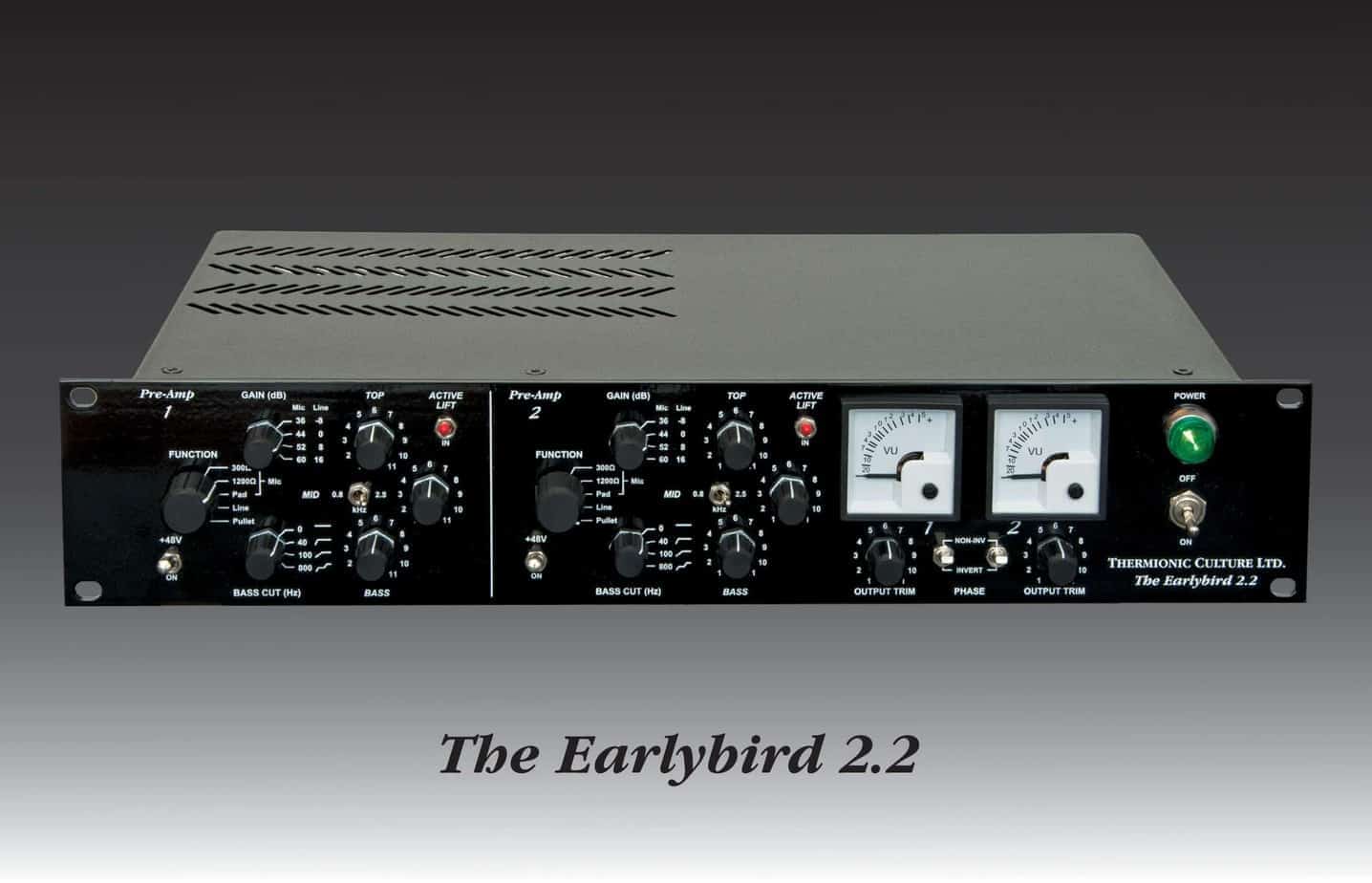
Thermionic Culture EARLYBIRD 2.2 Two Channel Preamp and Equalizer
The Earlybird 2.2 consists of two channels of extremely good quality valve pre -amplification. The circuit style utilises a ‘push pull’ ‘class A’ kind of amplification in order to provide eventually clean acquire, giving the lowest noise and distortion figures achievable inside a mic pre-amplifier.
The input and output transformers happen to be made by working collectively with Sowter transformers to provide outcomes which are optimised for this unit. This style operate provides the Earlybird 2.2 with the lowest phase shift and highest headroom feasible from a mic pre- amplifier.
This version in the Earlybird pre-amp design also incorporates additional functions such as 3 bands of active lift EQ with switchable mid range frequencies and higher pass filters, and a function switch to help interface the unit in distinct usage scenarios.
The vital mic-preamp settings like get, impedance, 48v power and phase are all catered for from the front panel controls.
The active EQ uses the exclusive ‘varislope’ EQ curves for the ‘bass’ and ‘top’ lifting controls. The ‘mid’ lift control supplies a broad, musical curve that may be centred at 800Hz or 2.8KHz by the frequency select switch. This curve interacts well using the leading and bass controls to supply a wide degree of tone shaping possibilities.
Because the active EQ operates in the feedback part in the circuit, switching the active EQ in does not, as a result introduce any further acquire stages into the signal path. This implies that the EQ may be used with out worry of introducing unwanted artefacts from additional gain stages.This probably tends to make recording just a little easier whenever a subtle amount of EQ might be added without having worry of signal degradation.
The higher pass filters are arranged so that the initial two switch positions offer 12dB/octave filters to cut out unwanted low frequencies at 40Hz or 100Hz. The final position supplies a filter with more of a shelving nature that will combine using the bass lift manage to give a simultaneous mid cut and bass lift if desired.
The Function switch enables the unit to take it is input from either the ‘mic in’ XLR sockets, the ‘Line in’ sockets or the’Pullet’ sockets. So the unit might be connected for different makes use of whilst remaining in an equipment rack. The variable impedance and pad settings on the switch permit the input circuitry of the Earlybird 2.2 to be optimised for use using a large assortment of mics and signal levels. They’re able to also be used for creative tonal alternatives if that’s the case preferred.
We locate that the range of functions attainable with the Earlybird 2.2 make it very versatile and coupled together with the outstanding sonic results it is a wonderful addition to any variety of studio which is used to record or mix sound.
The Pullet, will be the perfect companion for the Earlybird two.2 to complete a superb mastering equaliser.
Features:- 2 Channels of extremely high quality push pull’ ‘class A’ type of valve pre amplification.
- 3 bands of active lift EQ with 2 mid range frequencies and switchable high pass filters.
- Clean gain, giving extremely low noise and distortion figures.
- Essential mic-preamp settings such as gain, impedance, 48v power and phase are all catered for by the front panel controls.
- Can be optimised for use with a large variety of mics, signal levels and different uses whilst remaining in an equipment rack.
- Function switch will allow the unit to take it’s input from, mic. in, line, or the Pullet sockets.
- Massive clean output, but can be trimmed by output level controls, some colouration can be obtained if desired.
-
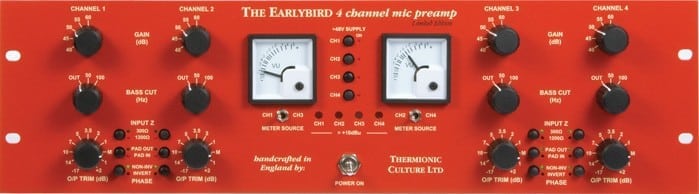
Thermionic Culture Earlybird 4 Channel Microphone Preamplifier
The Earlybird four contains 4 channels of extremely good quality valve pre-amplification. Originally produced in black in 1999, this is a specific “revival” restricted edition in red (limited to 49 only). The black edition is still available together with the updated circuitry..
As the individual channel circuitry in this version on the Earlybird has been simplified so as to offer 4 channels in a single 19” unit, so the person channel specifications have risen. As a result generating this the most normal sounding, top quality version on the Earlybird preamp to date.
Effectively giving the user the cleanest attainable valve obtain using a range from 3dB to 62dB along with a switchable input impedance to help in matching the unit with various microphones.
This can be one of Thermionic Culture’s all handwired items with point to point wiring all through.
The circuit style utilises a ‘push pull’ ‘class A’ kind of valve amplification in order to supply in the end clean obtain, giving the lowest noise and distortion figures possible in a microphone amplifier.
The input and output transformers have received specific focus and by operating with each other with Sowter transformers, patterns have already been produced that bring much better results than ever prior to. The lowest phase shift and highest headroom are each advantages brought by these designs.
It is uncommon to hear a mic amp with all the Earlybird 4’s qualities and following years of improvements Vic Keary proudly declares this “The very best, most actual mic. amp ever ”. We hope that on hearing the unit’s gorgeous results yourself, you will agree with Vic.
The pair of VU meters show the signal levels for two selectable channels. VU meter A is switchable in between channels 1 and 3. VU meter B is switchable amongst channels 2 or four. 4 red LEDs light up when the output of the amplifiers exceeds +10 dBm, even though don’t worry – there’s nonetheless 20dB of headroom left within the Earlybird!
Features:
- 4 Channels of extremely high quality push pull’ ‘class A’ type of valve pre amplification.
- Clean gain, giving the lowest noise and distortion figures possible in a mic. Amp.
- Hand wired with point to point wiring throughout.
- Lowest phase shift and highest headroom.
Controls on each channel for:-
- Switchable input impedance to help in matching the unit with different microphones.
- Switchable 48V phantom power .
- Switched gain 42 dB to 62 dB, 20dB pad.
- 2 position high pass filter.
- Variable output trim with phase inverter.
- Vu meters switchable between channels.
- Peak overload indicators.
-

Thermionic Culture Fat Bustard MKII 12 Channel Valve Mixer
The Fat Bustard mk II is an all valve passive input summing mixer. It has 14 inputs with four stereo inputs, four mono pan-able inputs and 2 ‘Aux’ inputs with a pan switch. The Fat Bustard is exclusive in it’s outstanding sound high quality as well as the additional degree of manage and processing it offers more than the stereo mix output. The mk II version is now the normal production model and it has been upgraded to consist of a monitor output with level handle.
A lot in the eye-catching sound supplied from the Fat Bustard is down towards the option of valves utilized. The summing is carried out by a pair of 5965 valves and also the output stage uses a pair of 6SN7 valves. This combination gives an incredibly big volume of headroom plus a exclusive smooth sounding response. It’s also worth noting that the unit has “semi-floating” inputs and unbalanced outputs. This was a choice created in the design stage purely because the unit sounded much better this way and performed excellently when connected for use in all circumstances.
The Fat Bustard employs our distinctive “varislope” curves for top rated and bass lift. Because the control is turned up, the peak frequency in the curve becomes a lot more extreme so as to add heavier bass/brilliant best – without the hardness present in solid state eqs. The bass and best cuts provide a selection of choices to tailor the sound – too many to list right here. They can be obviously independent from the lifts. All controls influence both stereo channels equally.
The ‘Attitude’ handle will be the subsequent to control the sound of the mix.This switched control steadily increases the amount of harmonic distortion inside the stereo summing stage. It is fairly subtle (at the least within the reduce positions) to provide just the best level of 2nd harmonic content to get a stereo mix. At higher positions the mix might be rather aggressive.
The stereo spread control permits the stereo to become widened by a continuous quantity more than a selectable frequency range.
The ‘Spread filter’ handle enables the frequency above which widening happens to be selected from total band widening to only widening above 5KHz. Again, this handle might be employed to vary the tone in the stereo mix at the same time as the stereo width. Together with stereo widening at greater frequencies.
The ‘Bass to Centre’ handle permits bass frequencies inside the stereo mix to become summed to mono for two diverse low frequency ranges, plus there is a setting for all frequencies to mono.
A Stereo ‘balance’ control and rotary 31 position ELMA switch for ‘Output level’ give total control over output levels.
The ‘Monitor level’ control, int/ext switch and extra outputs provide a helpful way to connect and control monitors towards the Fat Bustard. Particularly beneficial when the Fat Bustard will be the only mixer becoming employed. If this is not a requirement then the int/ext switch in conjunction with all the monitor outputs can be used to provide an insert in/out switch.
Features:- All valve 14 channel passive summing mixer with many extras !
- Pan controls on 4 channels.
- Unique Varislope Top and Bass lifts plus filters.
- ‘Attitude’ control to add harmonics.
- Stereo width controls / Bass to centre and mono.
- Precision ELMA switch to control main level (fadeable).
- Monitor outputs with level control and switching.
- Hand wired with point to point wiring throughout.
- Exceptional sound quality- very low distortion except when required and massive ‘headroom’.
- Frequency response extends from below audio range to well above.
-
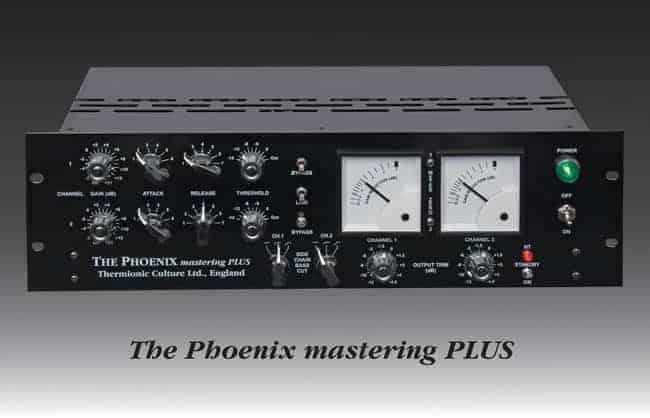
Thermionic Culture Phoenix Mastering Plus
his is the latest development in the evolution of the classic Phoenix compressor, first introduced in 1998. After requests from mastering engineers the Master Phoenix was introduced in October 2006. This was more recall-able with indented pots and slightly different power supply and metering circuit, in which trimming the meter alters the current through the compression valve so compensating for valve ageing.
The compression curve of the mastering Phoenix is slightly gentler than that of the standard one, but it does have a more “positive” effect. This earlier version has 6dB lower gain compared to the standard Phoenix.
The Master Phoenix is in use in many studios and mastering suites around the world, and we do know that one of its users, Ray Staff of AIR London Studios won the MPG award for Best Mastering Engineer in 2009.
The new Mastering Plus is a much upgraded version employing precision Elma switches for the Gain and Threshold and Alpha switches for Attack and Release. Omeg indented pots are used for the Output Level for fine control.
Side Chain Bass Cut switches, which have become an essential mastering tool have been retained. In stereo mastering, with the link switch in, there are effectively 5 frequency options as the compressor side chain will work at the average of the switch positions.
A Standby switch is introduced to prolong valve and component life and this has had an unexpected effect, see. *
Mullard and Siemens NOS valves are used exclusively for lower noise and long life stability.
The Gain is now identical to that of the standard Phoenix so that extreme compression effects are possible .
Easy adjustment of Meter Zeros, especially important in stereo mastering, is now enabled by front panel access to the trim controls, situated between the 2 meters.
*some users have found that analogue tape type distortion is created when the unit is operated with Standby on.This was unintentional but some people may find it interesting.
- All valve signal path and side chain, point to point hand wired in England.
- Subtle control with ‘soft knee’ compression more compression effects when pushed hard.
- Stereo link for mix buss compression.
- Side chain filters to enable compression of all frequencies except bass.
- Flat frequency response over full audio range and beyond.
- Very low phase shift and harmonic distortion (unless pushed hard).
- Push-pull design gives a natural warm sound with high output level.
- Output trim controls for fine adjustment or lower level operation.
- Balanced ins and outs with custom made Sowter transformers.
- Bypass switch on each channel removes all electronics.
NEW SPECIAL FEATURES
- Elma switches for gain and threshold controls.
- Alpha switches for attack and release controls.
- All Mullard and Siemens NOS valves.
- Easy recall– ability.
- Zero adjustment on front.
- Precise calibration.
- More gain than earlier Master Phoenix.
- Standby switch to prolong valve life.
- Distortion effects can be created with standby on.
-

Thermionic Culture PHOENIX Valve Compressor
The Phoenix SB is now the standard production version of the Phoenix compressor. Alongside the now classic circuit design of the original Phoenix, it incorporates the side chain filter controls from the previous standard Phoenix SC model with the new addition of an HT standby switch.
The additional HT Standby switch allows the user to put the Phoenix into a low power standby mode that is designed to increase the life of the unit’s valves and capacitors. When first switching on, or if the unit’s not in use for a while, have the Standby on. Switch off Standby and it will instantly come back to full life.
We have also placed the meter zero controls on the front panel for much easier access. Both meters should read “0” when the Phoenix is off standby and not compressing. They can be adjusted easily by any user without harm to the unit.
The side chain filters can be used to cut the Phoenix’s compression response to bass frequencies. The filter operates below either 150Hz or 300Hz on each channel and when stereo link is engaged the filters operate at the average of the two sides. This enables the user to choose from 5 filter frequencies when in stereo operation.
The Phoenix is well known for its smooth “soft knee” compression characteristic and excellent specifications. This means that it can be used as a compressor that will not harm your signal quality, whilst subtly controlling dynamic range. It is also possible to drive the unit harder to produce harmonic distortion and higher ratio compression if desired. Many users have found these features bring life to mixes or individual instruments, and control vocals, with a natural “warm” quality.
Contrary to the above, users have found that if the unit is operated in standby mode (it still passes audio) a “symmetrical” distortion occurs, not unlike that produced by overloading analogue tape. Perhaps this fact alongside an exaggerated compression curve lends to the Phoenix in standby mode another dimension.
- All valve signal path and side chain, point to point hand wired in England.
- Subtle control with “soft knee” compression, but more compression effects when pushed hard.
- Continuously variable attack, release and threshold controls.
- Stereo link for mix buss compression.
- Side chain filters to enable compression of all frequencies except bass.
- Flat frequency response over full audio range and beyond.
- Very low phase shift and harmonic distortion (unless pushed hard).
- Push-pull design gives a natural warm sound with high output level.
- Output trim controls for fine adjustment or lower level operation.
- Balanced ins and outs with custom made Sowter transformers.
- Bypass switch on each channel removes all electronics.
- Standby switch to prolong valve life.
- Distortion effects can be created with Standby on.
-

Thermionic Culture PULLET Passive Stereo Equaliser
The Pullet is a passive EQ which features a sharp focus on mid range frequencies.
The Pullet will supply the EQ network to a signal but will reduce the signal level in order that a preamplifier using a acquire of as much as 40dB is required to be able to lift the signal back as much as unity get when the Pullet EQ is set to ‘flat’ or bypass.The preamplifier is utilized in the output of the Pullet. The reality is the fact that a lot of people will currently have a preamplifier that can be utilised, either a standalone outboard unit, or perhaps a mic-preamp built into a console, so the Pullet could make a good deal much more use from the preamps that would otherwise be sitting about unused throughout a mix.
The Pullet supplies a variation on the classic passive EQ styles that have proved so common (eg. Pultec).
Nonetheless, there’s far more control and choice within the mid range frequencies than may be present in preceding designs.
The Pullet can provide a variable Q boost of as much as 21dB over 11 different frequencies and fixed Q cut at 11 frequencies. There is also a ‘High top’ handle that gives a switched set of shelving style filters to boost or cut higher frequencies.
The Pullet was originally designed for use with the Earlybird 2.2 mic preamp but early on a decision was produced to alter the style so that the Pullet might be utilized with any mic preamp available using a get of as much as 40dB.
The input impedance on the Pullet is set at 10kO as well as the Sowter input transformer is utilised to ensure that it is going to function typically when placed within a chain immediately after any piece of gear.
The Pullet can create some radical EQ curves because of the extremely high amount of increase and cut available however the passive nature from the EQ will always let the outcomes to sound as all-natural as possible.
It’s “balanced” in and out on XLR connectors. Brief, premium quality leads are supplied for connection to mic amps.