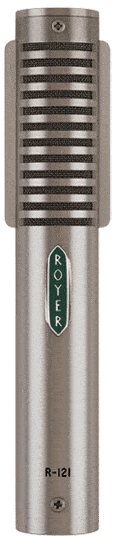
R-121 Studio Ribbon Microphone
Released in 1998, the award-winning R-121 is our flagship microphone; the world’s first radically reengineered ribbon microphone and the model that reintroduced ribbon mics to engineers around the world. We did away with the large, heavy, fragile “classic” approach to ribbon microphones and went in a completely new direction. The R-121 gives all of the warmth and natural sound that experienced engineers have long turned to ribbon mics for, but in a compact, light-weight, high output and tough-as-nails package that was unheard of in a ribbon mic before the R-121. In its 10+ years in the market, thousands of R-121’s have been sold around the world and it’s well established as a standard for tracking electric guitar and brass.
The R-121 redefined ribbon microphones so completely that Recording Magazine wrote “…the Royer R-121 is destined to become one of the classic microphones of the 21st century.”
Like many of the best classic ribbon mics, the R-121 has a figure-8 pattern, output level comparable to a dynamic mic, and a warm, realistic tone and flat frequency response. But that’s where the similarities end. By using advanced materials and a blend of cutting edge and old-school, hand-build construction techniques, the R-121 is an extremely versatile and user-friendly ribbon mic that can stand up to the most demanding tasks. Cranked up electric guitars, close up brass, drums – you name it, the R-121 will help you record it with realism you have to hear to believe.
We build the R-121 solid enough to give it a lifetime warranty. We expect you to own it for as long as you record, and we’ll stand behind it the whole way.
Patented Offset Ribbon Technology
The R-121’s proprietary offset ribbon transducer (Patent # 6,434,252) is the first of its kind, positioning the ribbon element closer to the front (logo) side of the microphone. This arrangement gives the ribbon more room to move within the prime magnetic field while maintaining full frequency response during high SPL recordings. It’s an integral piece of the magic of all Royer R-series microphones.
- High SPL Capabilities
- No internal active electronics to overload or produce distortion up to maximum SPL rating
- Extremely low residual noise
- Ribbon element is not affected by heat or humidity
- Absence of high frequency phase distortion
- Equal sensitivity from front or back of element
- Consistent frequency response regardless of distance
We’ve always said Royers “hear like your ears.” Put one up and you’ll know what we mean. The R-121 accurately reproduces what you hear at the sound source. Most microphones add their own characteristics; some have hyped highs and lows with scooped out mids, some are extremely sizzly in the highs, some accentuate midrange, some respond to nothing but low end… They all serve a purpose and have their place in the studio. But if your goal is to capture something the way it really sounds – that unbelievable electric guitar, that wailing trumpet, that full kit – and you’ve found that recording that sound was next to impossible, put up an R-121 and get ready. The R-121’s response is flat and well balanced, with a deep, non-boomy low end, well defined and realistic mids, and a smooth and natural sounding high end response that’s never edgy or sibilant.
When it’s time to mix, push up the faders on your ribbon-recorded tracks and you’ll see why so many of today’s engineers rely on R-121’s. When your tracks sound real, fitting them into the mixis a breeze.
On playback you’ll find the sound is natural and alive, with a panoramic, ambient feel much like what you heard when you were standing in the room with the instruments(s) you were recording.
Recording LOUD!
Need to record at insane levels? No problem! The R-121’s maximum SPL rating is 135dB at 20 Hz and it can handle that for years. In practical terms, that means you can put your R-121 directly in front of a souped up 100-watt Marshall and open it up without microphone distortion or damage to the ribbon. We don’t recommend trying this with other ribbon mics, but the R-121 was built to take it.
Two Mics In One
At distances of three feet and closer, the back of the R-121 records slightly brighter than the front side. This can be extremely useful when recording acoustic guitars, vocals, and other sound sources that you may need a slightly brighter response on.
2 Mics In One – Recording on the Back Side of the R-121, R-122 and R-122V
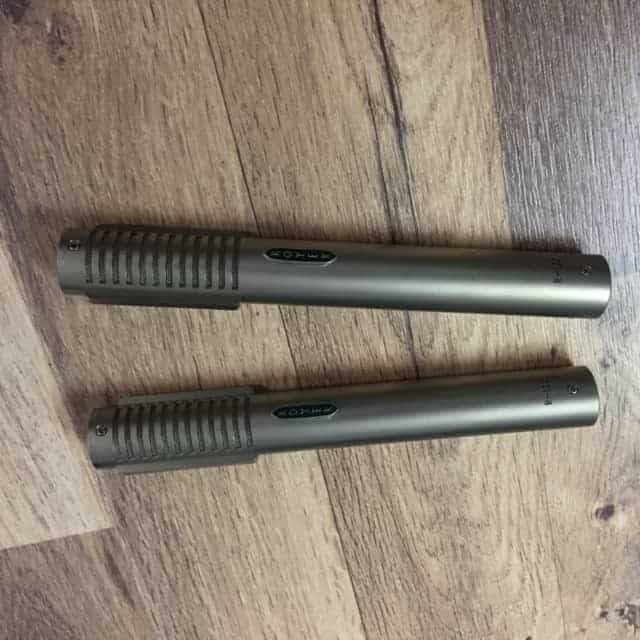
 In 2002 we introduced the R-122, the world’s first phantom powered, active ribbon™ microphone. It was a revolutionary development in ribbon mics, combining impedance matching circuitry with condenser-like output levels that allowed the R-122 to be used on even the quietest sound sources. It also allowed the mic to be paired to virtually any preamplifier.